🇳🇵Langtang Valley - Hiking in the Himalayas
Hiking fuelled by yak cheese
Since I started planning this trip, I wanted hiking in the Himalayas to be in the itinerary. The landscapes seemed so vast, and the scale of the mountains larger than anything in Europe, while also being close enough to China to have tasty chowmein 5000 metres up in the mountains. Does it get better?
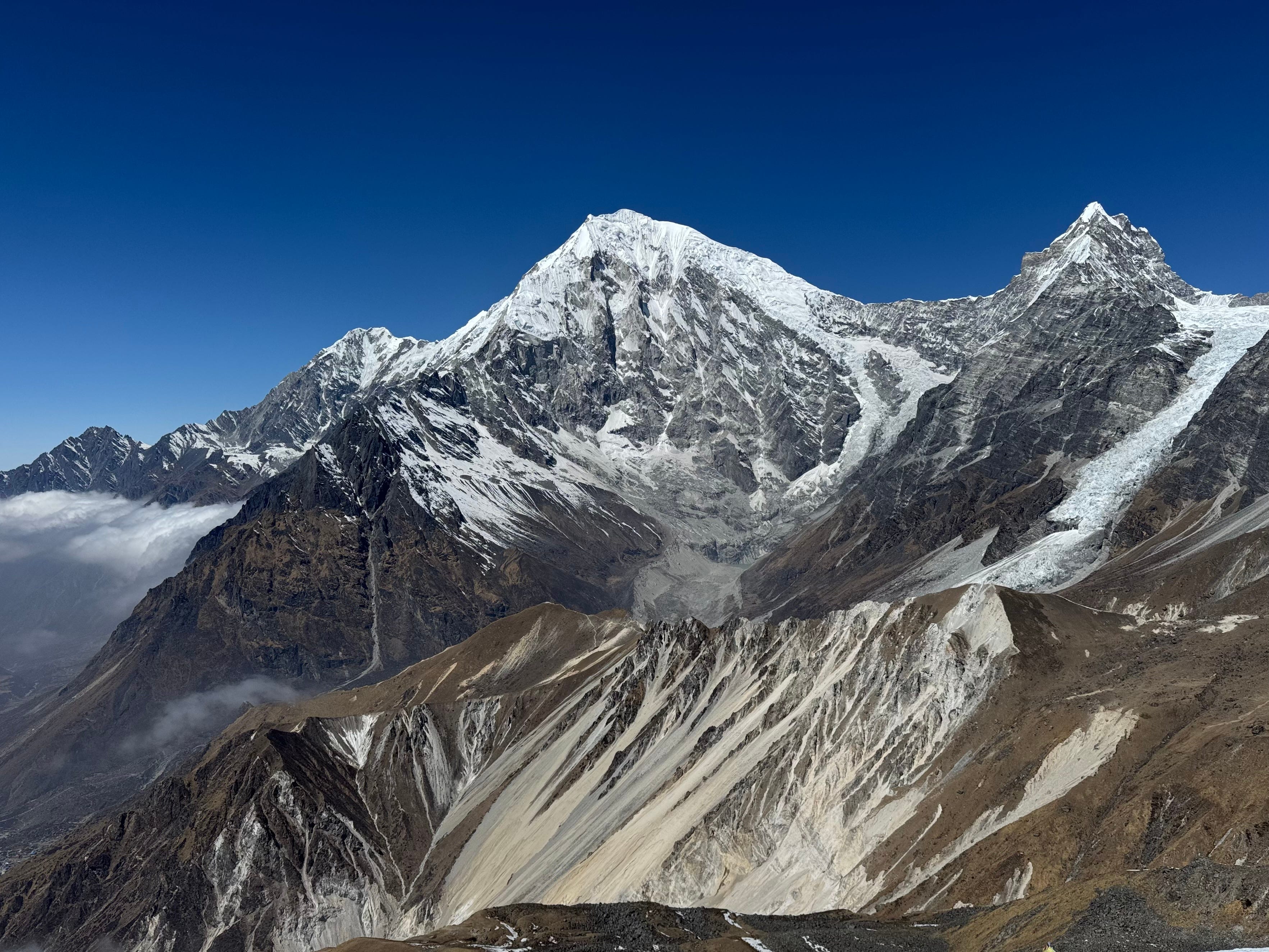
Why the Langtang valley?
While researching hikes in Nepal a little, I was a little spoiled by choice. Most of the popular hikes seem to take around 2-3 weeks to complete, and while I love hiking, the longest I’ve hiked consecutively was 4 days in Kyrgyzstan. I didn’t know if I wanted to commit to a timeframe triple that.
I’ve not heard of the Langtang valley before my trip, but it seemed like a good shorter alternative to the longer routes. I chose it for a few reasons:
It’s a good duration, taking around 8 days of hiking with transport on either side.
It wasn’t too far from Kathmandu compared to alternatives.
It’s not got a road on the side of it, compared to e.g. Annapurna Base Camp and Annapurna Circuit.
It exists because it’s supposed to be a beautiful hike, unlike, e.g. Everest Base Camp, which seems to only be a popular route because it takes you up the highest peak in the world - not necessarily because it’s an enjoyable route.
I could do it solo without a guide.
Hiking solo?
I wanted to hike alone as I haven’t done it before, and I wanted to have the experience of trekking without a guide, to compare to the hiking I did in Kyrgyzstan. Technically, from April 2023, foreigners need to trek with a guide in Nepal. The rule isn’t always being enforced on the ground, though.
Having researched a little, I was fully prepared to complete the hike on my own. The guide to hiking Langtang by Going the Whole Hogg was fantastic for this, arming me with all I needed, including detailed offline maps. The website is run by a couple who seem to hike a lot, and their guides seem to be the best you can find for hiking in Nepal. Their YouTube channel also has some great companion guides and cinematic montages of the hikes.
Having spent some time in Nepal, I found that many backpackers are keen to join in on plans at short notice. This is massively eased by chats in the Hostelworld app, which is a platform for booking hostels. A few days before setting off, I had a slight change of heart and sent a message to a chat in the Hostelworld app asking if anyone wanted to join me on the hike. If nobody replied, I’d have just done the hike alone. As luck would have it, I ended up in a group with 6 other travellers, all setting off on the same day. Everything worked out, and our little group got along great.
Sorting hiking gear in Kathmandu
The Thamel district in Kathmandu is home to most of the tourist accommodation and hiking shops in Kathmandu. Every other shop seems to be a hiking shop, so the choice is immense. It somewhat feels like the Mecca of hiking gear, letting you buy or hire very high-quality gear for ridiculously low prices.
To narrow things down, I got all I needed from Goreto Gear Traders, as recommended by the online guide I was using for the trek. It has an exceptionally good rating on Google Maps (5 stars with nearly 1000 reviews), and I can completely see why - the staff are super helpful, not pushy with selling you anything, and there’s no haggling. No haggling is a real breath of fresh air in Asia - you never know if you’re getting a tourist price or the local price when buying something, and the constant haggling is exhausting. In the end, I sorted everything in about 15 minutes, and ended up paying £65 for:
A packable down jacket
A thermal top and bottoms
A sleeping bag
A hiking pole
Gloves
A long-sleeve t-shirt
Hiking socks
Microspikes
Thankfully, a lot of the gear was fake Arc’Teryx. As every Zoomer hiker knows, half of the joy of hiking is looking cool and appealing to your hypebeast past.
After leaving the shop, I realised I should have really rented most of the equipment as I won’t need much of it for the rest of my travels, but the prices were so low that it completely slipped my mind. Luckily, it was easy enough to sell a lot of the gear on to other travellers, hiking shops, or donate it.
The hike begins!
To get to the first village, Syabrubesi, we took a minibus that was being fixed right up until a few minutes before we departed. There were a few other groups of hikers with us, and I got to talk to one of the guides from another group. The conversation started with him berating me for not taking a guide or porter as “those could have been someone’s jobs”. This made some sense, as unemployment in Nepal is at nearly 11% (climbing up to 20% amongst young people), so many people are keen to be guides or porters. Point taken, though - don’t talk to the other guides or porters about not having a guide or a porter. The guy’s motivations were a bit interesting, though, saying that his favourite hike is Everest Base Camp because the guides and porters get paid a lot for working it. The other guides we met were much more chill. I guess this guy was just aggressively financially motivated.
After getting to Syabrubesi, it was early afternoon, so we decided to set off right away. Usually, people spend the night here before setting off, but that’s one of the pros of not having a guide - we could just decide to set off when we wanted to.
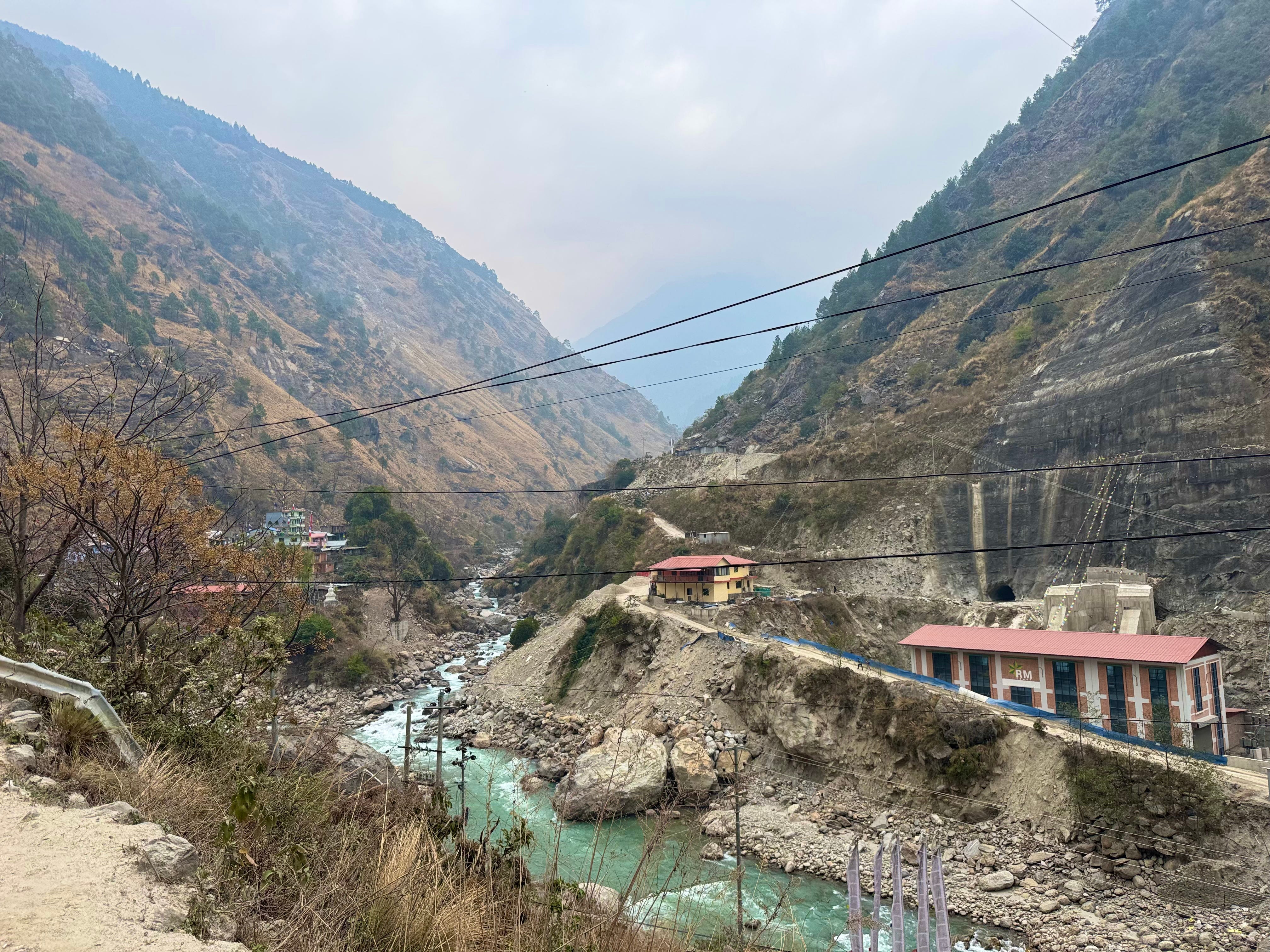
The first day was pretty scenic, mostly going through small villages and passing grazing goats and yaks. There were many teahouses along the way, allowing us to buy hot food, snacks, and drinks. Water was never an issue either - there were taps in most villages that you could fill up your water with for free, and sanitise it with water purification tablets. The tablets made the water taste a little like chlorine, but admittedly, I got a little fond of the taste after getting back to Kathmandu. When I tasted chlorine, I knew that the water was safe.
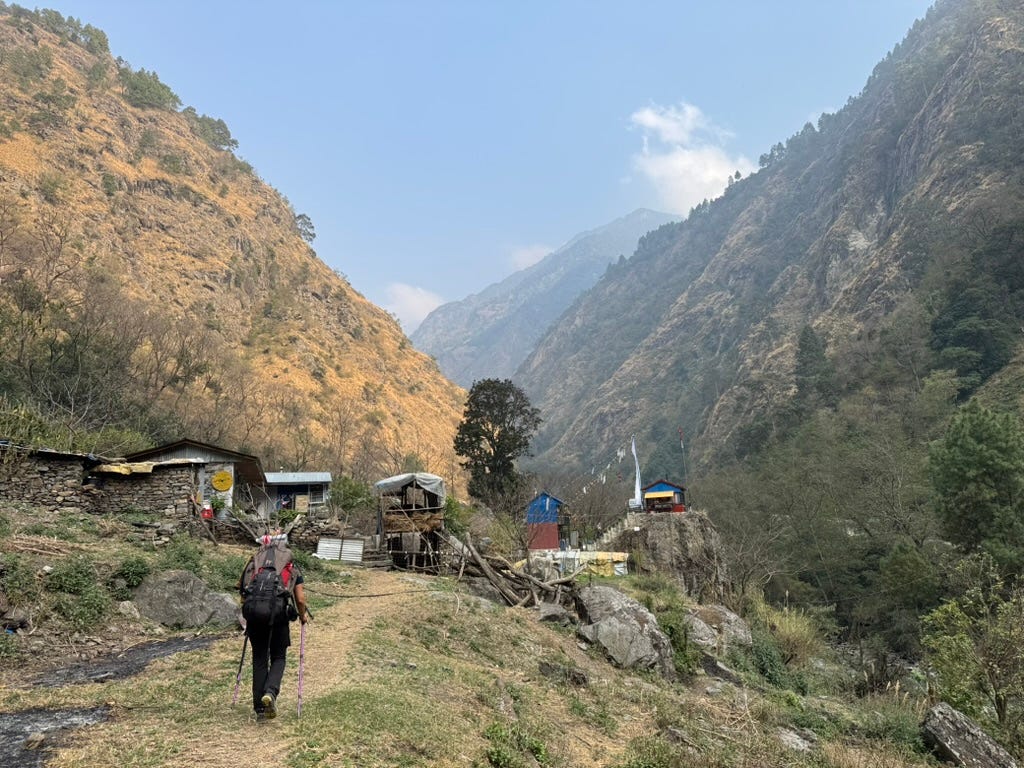
On the first night, we stayed in a village called Pairo, which is not included in many itineraries. That too is one of the great things about not having a guide - we could stay where we wanted, and not where the guides got commission for taking hikers.
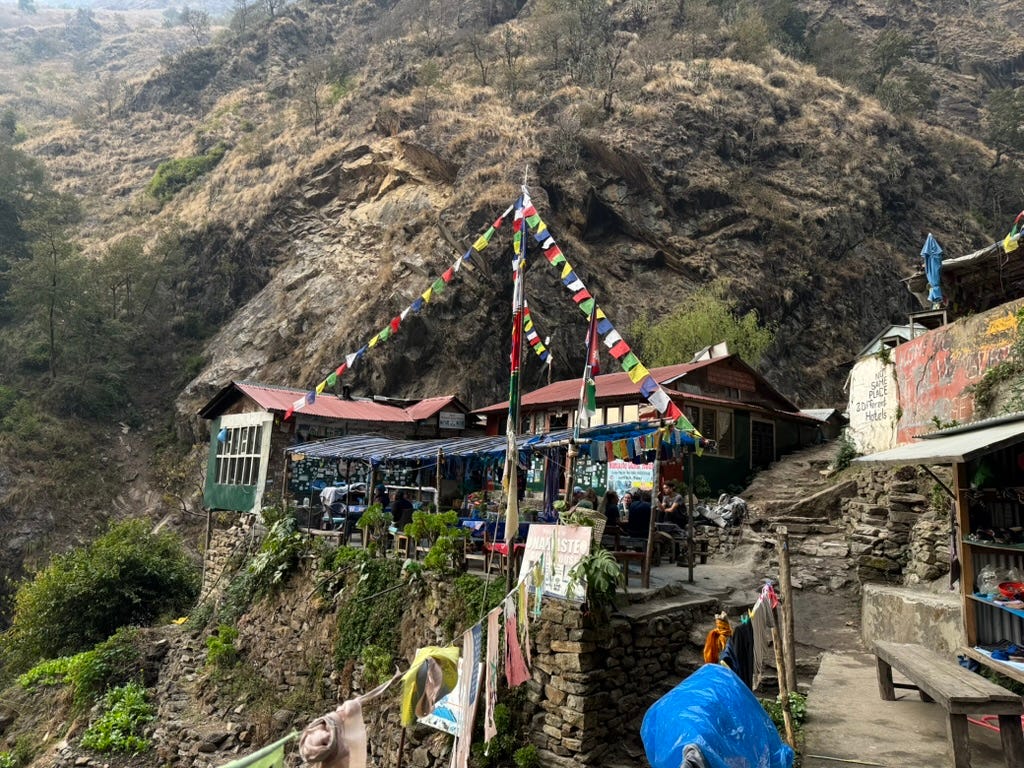
The view from Pairo was also amazing.
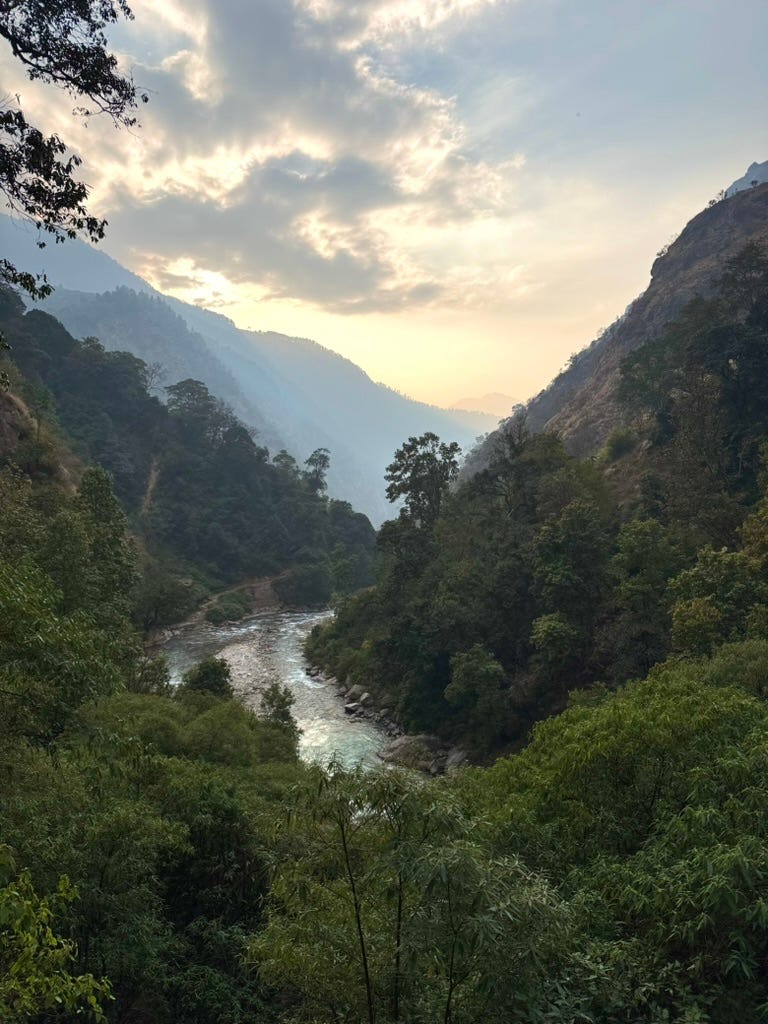
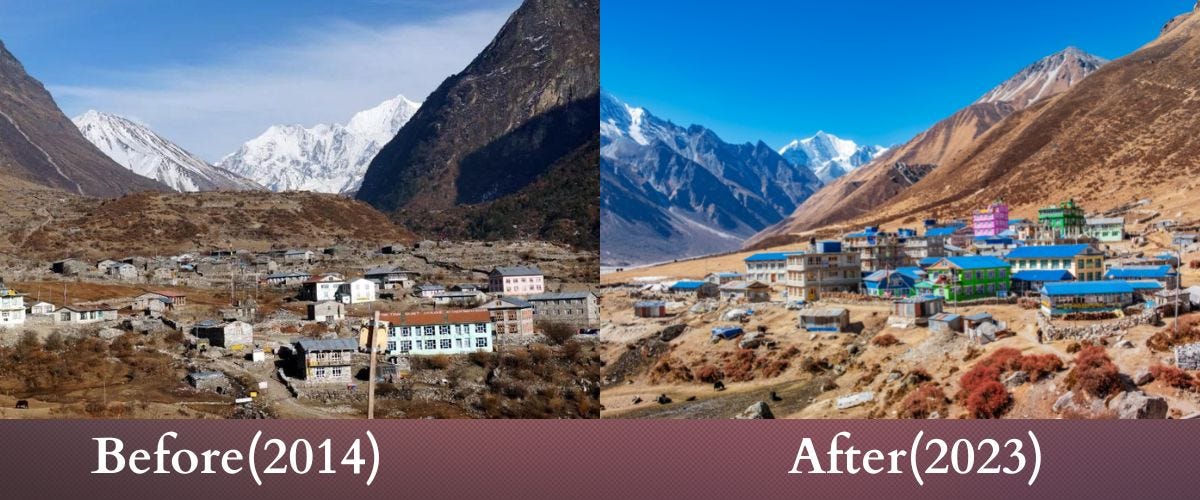
In general, the lower villages, such as Pairo, didn’t have great amenities, so we had cold bucket showers outside and didn’t have electricity in our rooms. This wasn’t an issue for anyone, though, as while hiking, you’re usually used to cold food, a shoddy tent, and showering in rivers. In some ways, this felt like a luxury. Paradoxically, the villages improved the higher we got up, despite there not being a road. The reason for this is that much of the valley was destroyed after the April 2015 Nepal earthquake, prompting the higher, larger villages to be rebuilt using materials that were flown in. In the higher villages, we usually got to stay in large buildings which had hot showers inside and electricity.
Saying this, food prices increased as we went up, as everything now gets delivered by horse or on foot. The food options were surprisingly diverse, with the teahouses providing fairly expansive menus. The staple while hiking in Nepal is Dal Bhat - rice, lentil dhal, and various additions such as pickles, curries, and salads. In essence, it’s a Nepali thali. What’s special about this meal is that you can get seconds of everything. I tend to eat significantly more than most people (I’m not sure where all of it goes), so this meal ticked all of the boxes for me - big portions, ideally a veggie source of protein, and it needs to be tasty. For vegan and vegetarian hikers, Nepal is a fantastic destination.
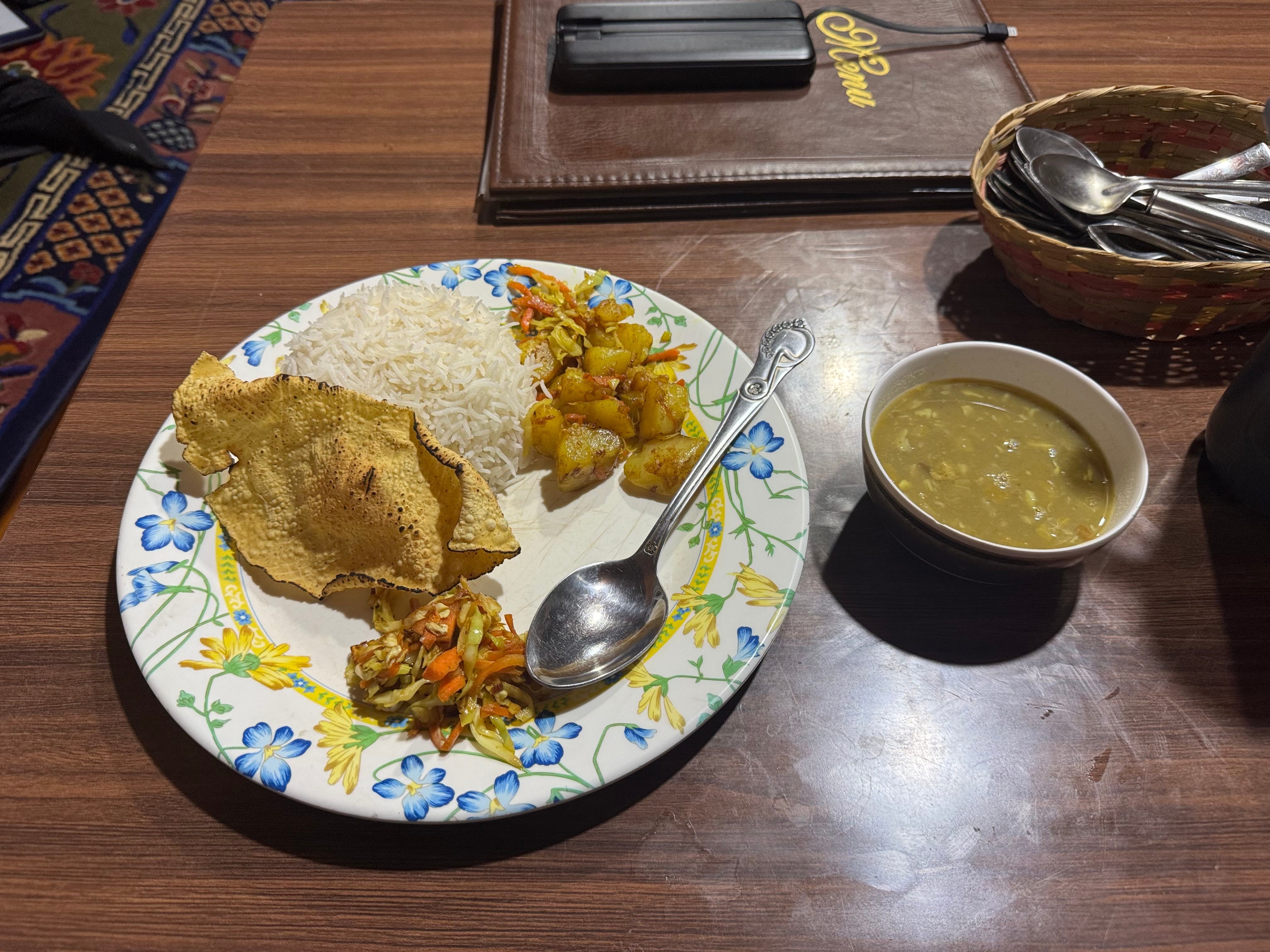
The menus also usually had varieties of chow mein, thukpa (Nepali soup), and pasta with sauces that would make an Italian weep. We ordered a “pizza” one time, and the Italian girl in my group (Sara) was really unimpressed.
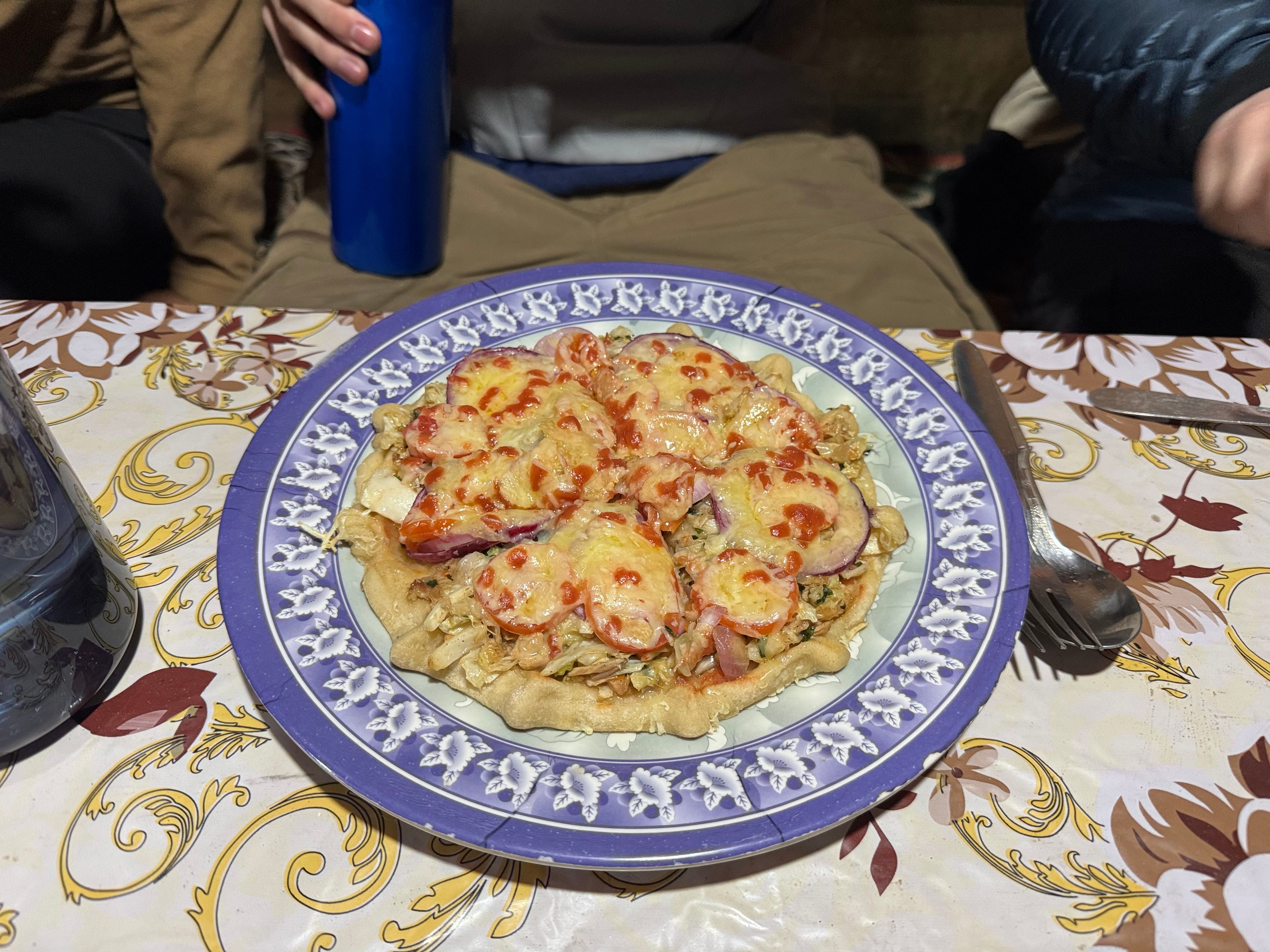
Not having a guide also meant we got to talk to the locals a lot, which was a nice touch. They were quite keen to recommend teahouses in other villages owned by their relatives or family members, usually letting us stay at them for free if we ate breakfast and dinner there. Saying this, we were hiking at the start of the season, so it’s possible that once the teahouses get busier, the locals are less keen to make such deals.
Going higher
As we traversed further iron bridges, the forest opened up, and the river got closer to us.
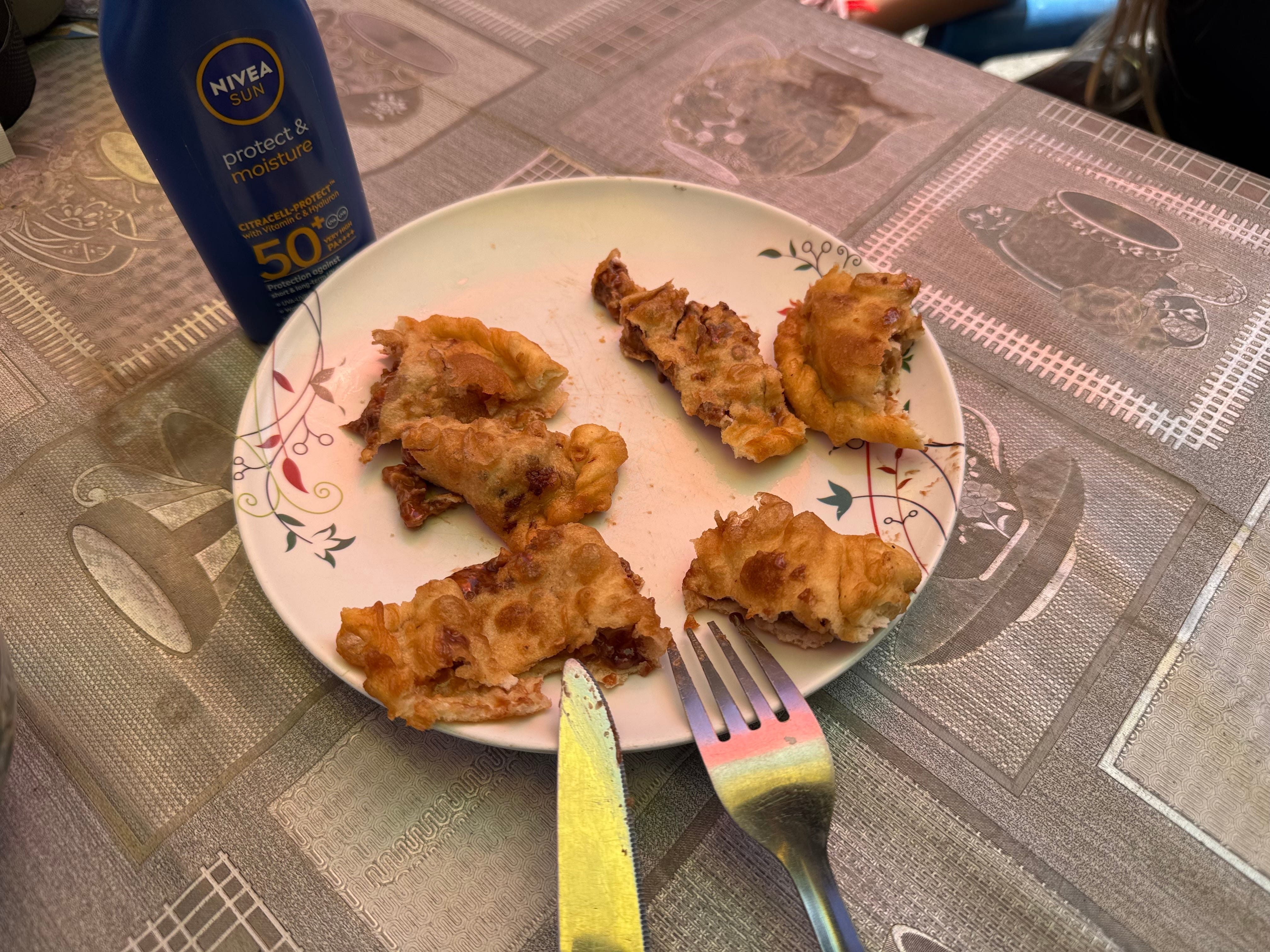
We stayed at a teahouse with particularly friendly locals here in a village called Lama Hotel. There, we had the atrocity that was the Snickers Momo - the Nepali deep-fried Snickers. The Scots aren’t so slick.
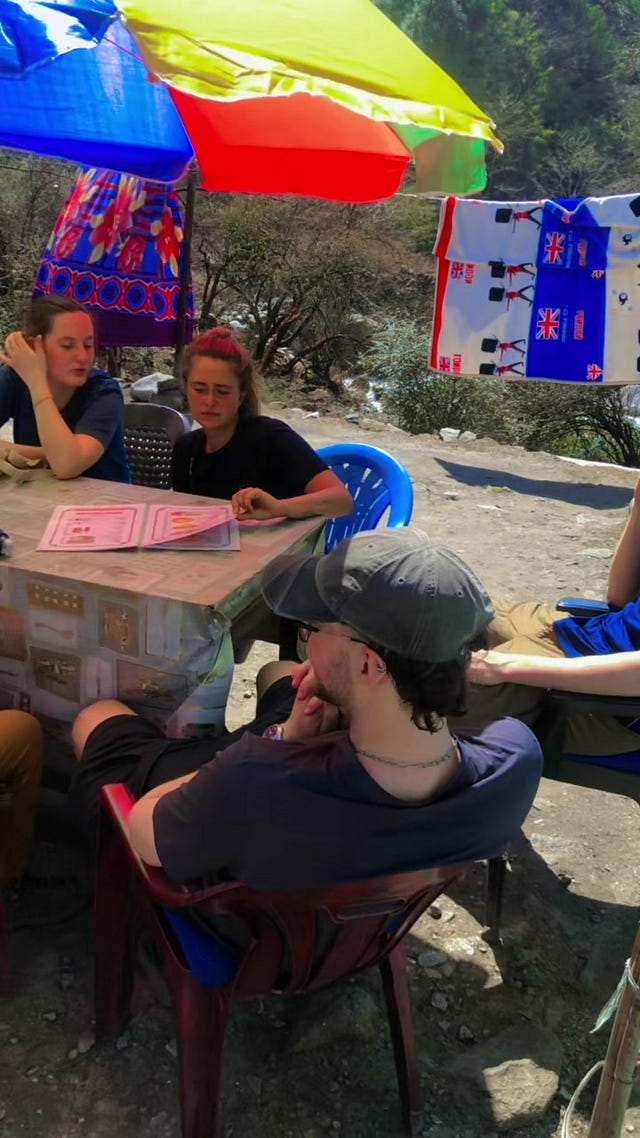
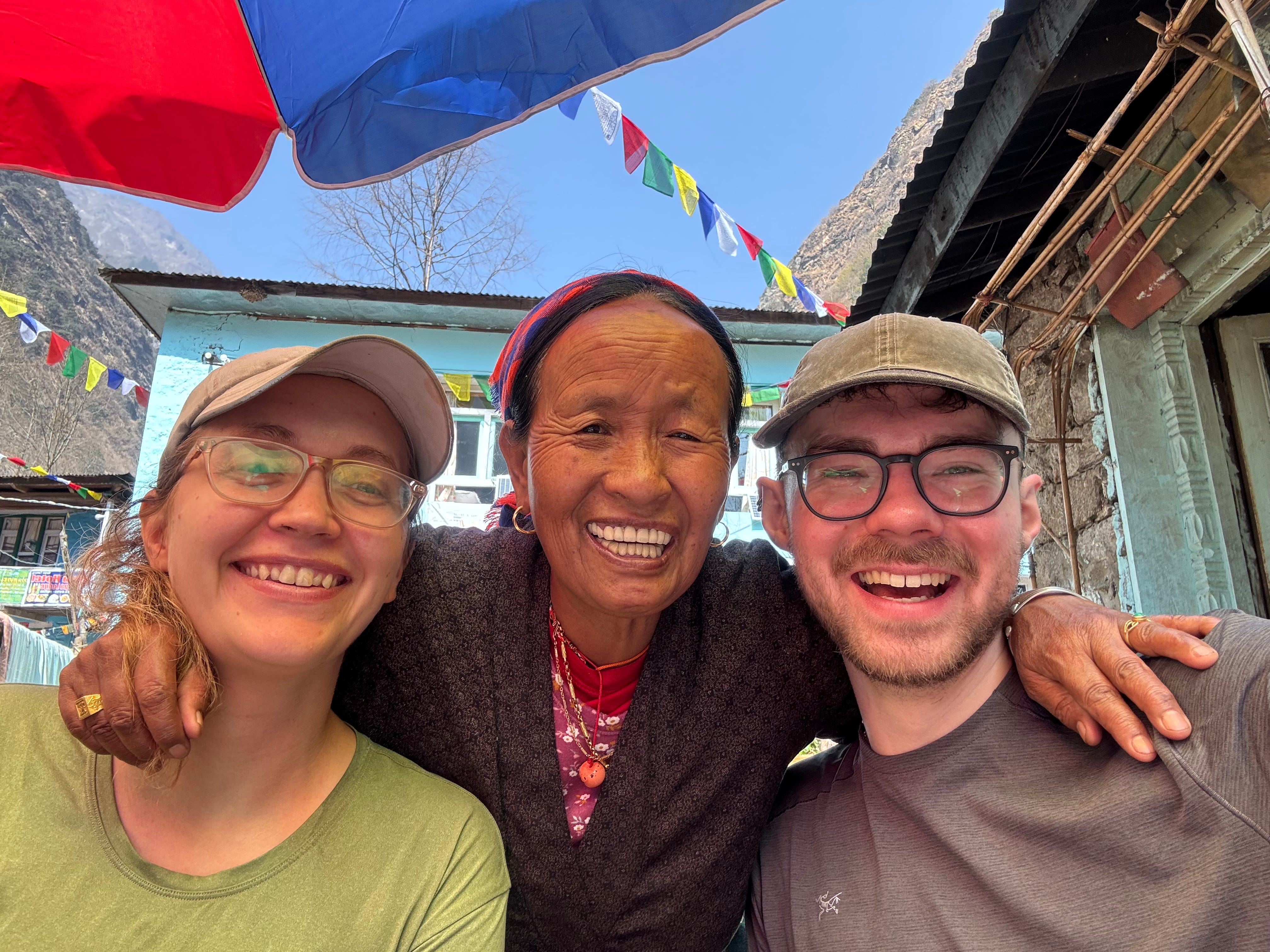
The owner of the teahouse, Karmu, was very excited to have such a large group of people eating lunch at her teahouse and recorded what she called a “TikTop” of us:
 Tiktok failed to load.
Enable 3rd party cookies or use another browser
I’ve lost count of how many promotional videos and photos for Nepali restaurants I’m in now; it seems to happen every other day that I’m in Nepal.
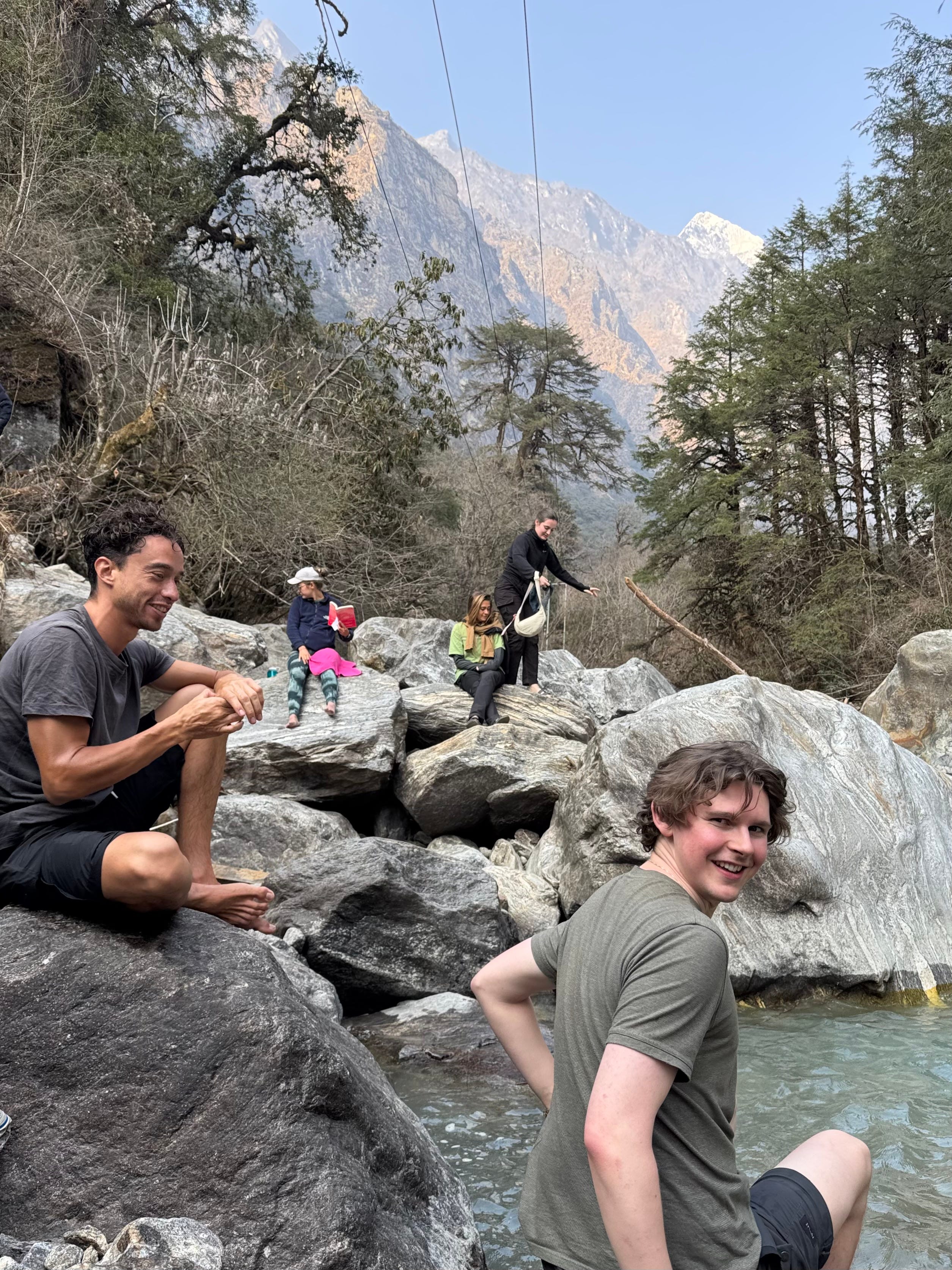
Being so close to the river, we could finish our second day with an ice-cold dip:
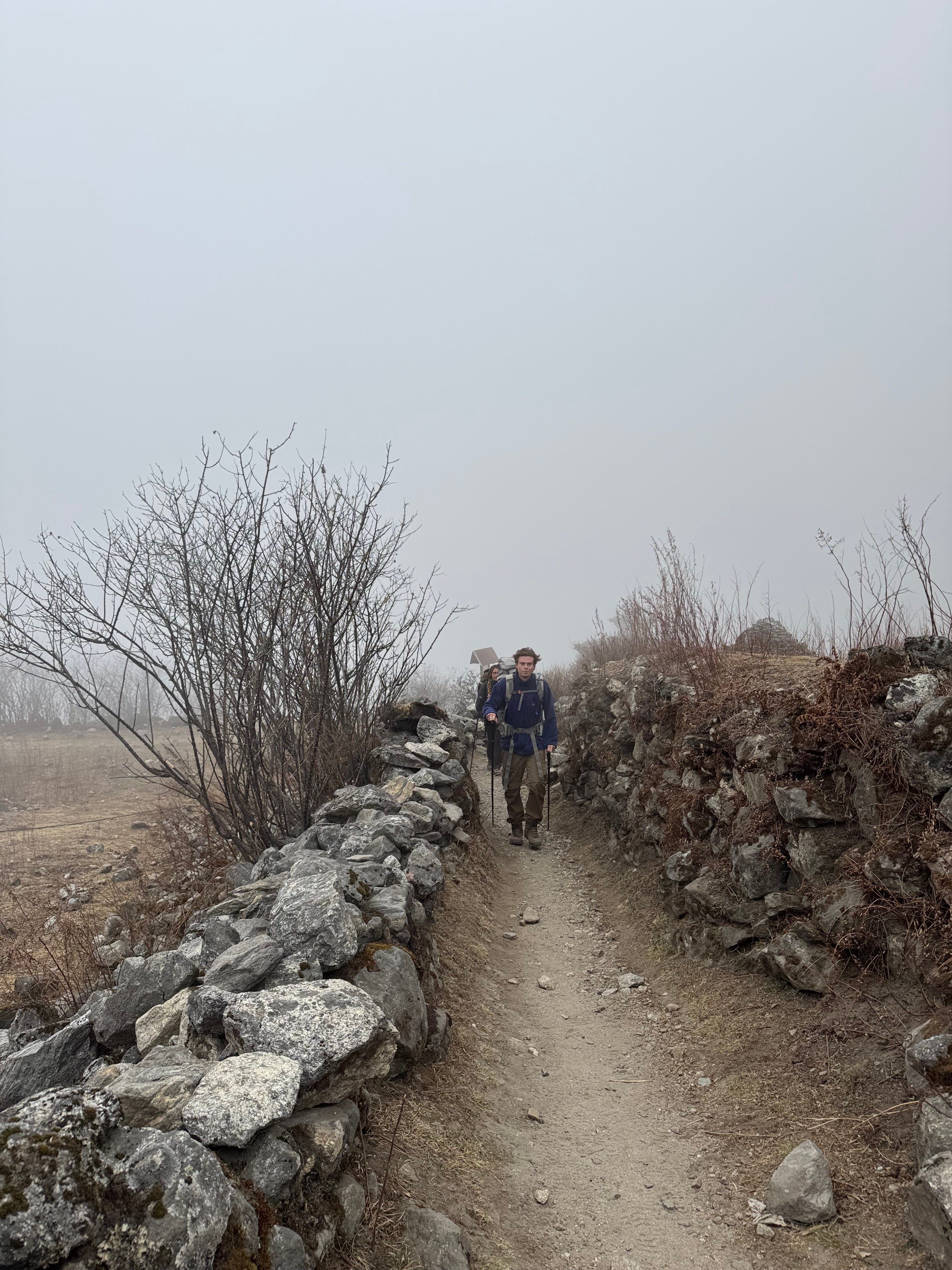
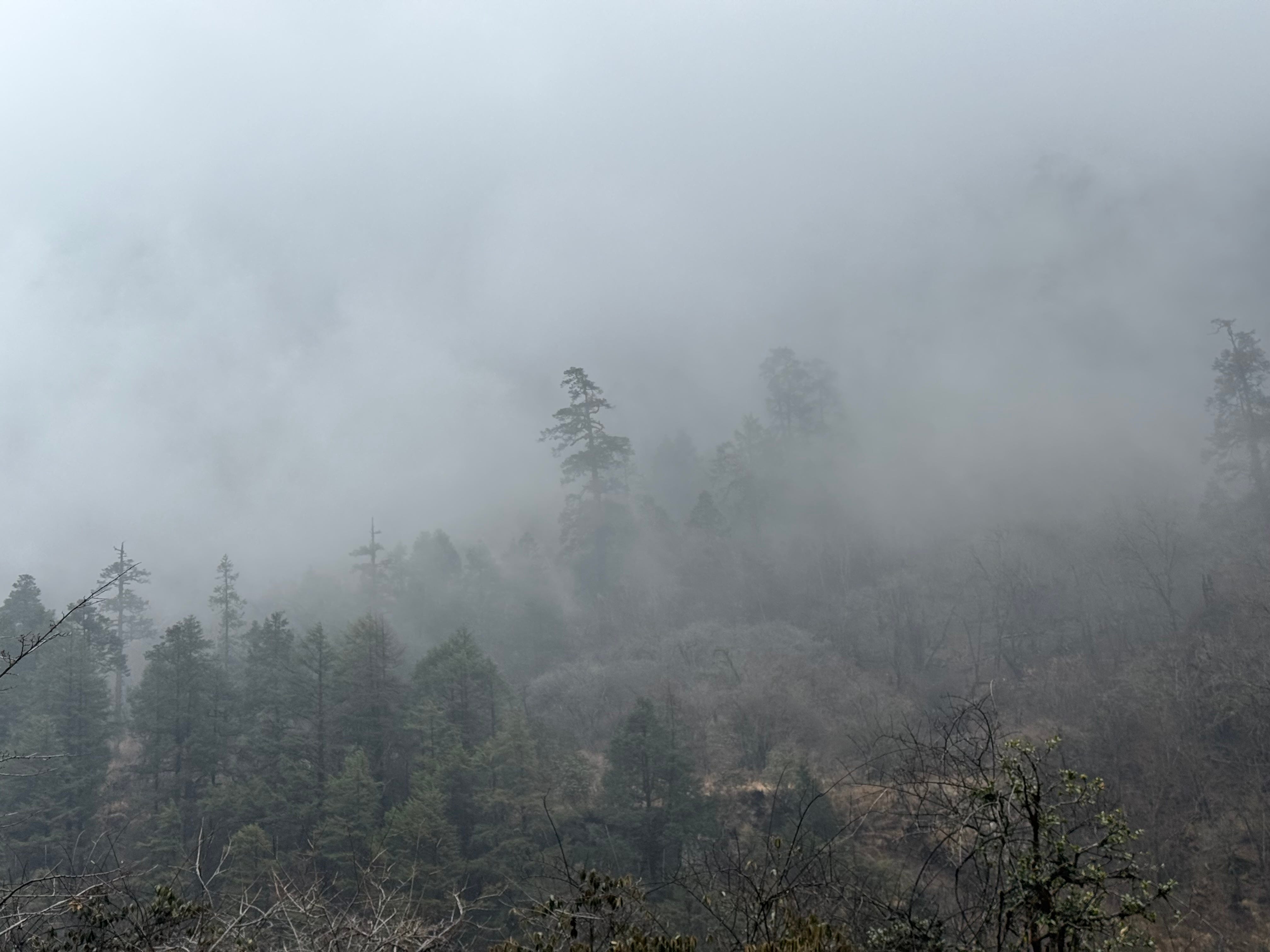
The subsequent day was a little mistier, obscuring most views. It was a bit cooler, too, which was welcome after two days of pretty sweaty hiking. It also made everything look like it’s out of Silent Hill.
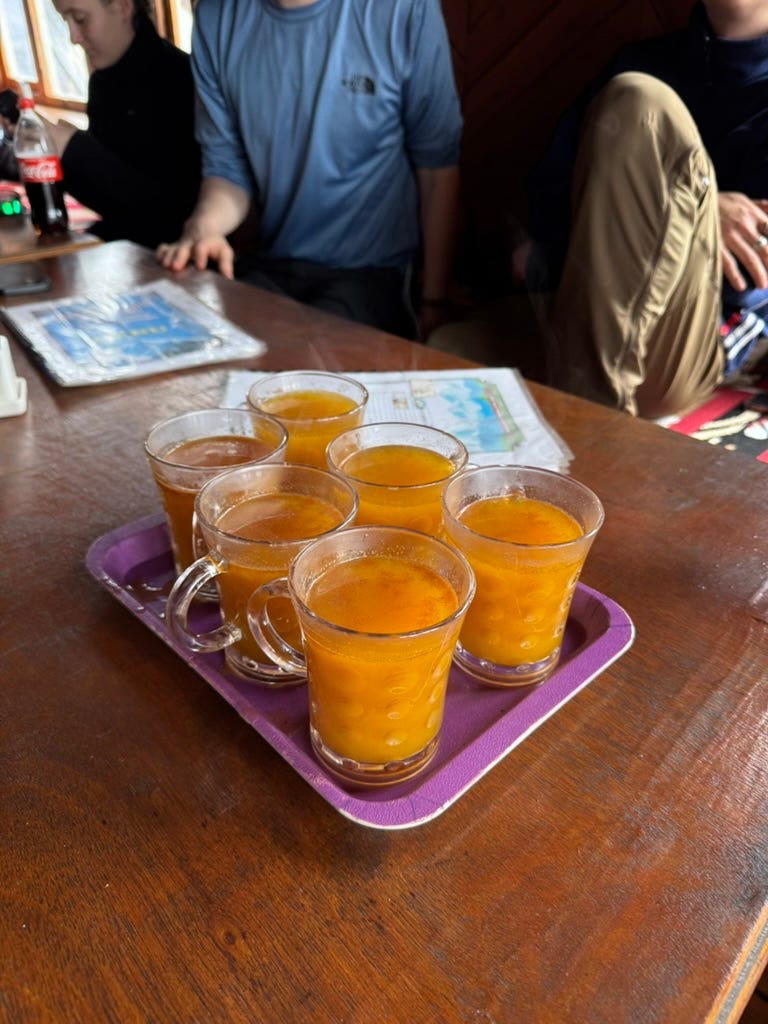
We trialled a local speciality at one of the teahouses - sea buckthorn juice. They serve it hot, and it tastes like a more sour, lighter orange juice. Incredibly refreshing after a few hours of hiking.
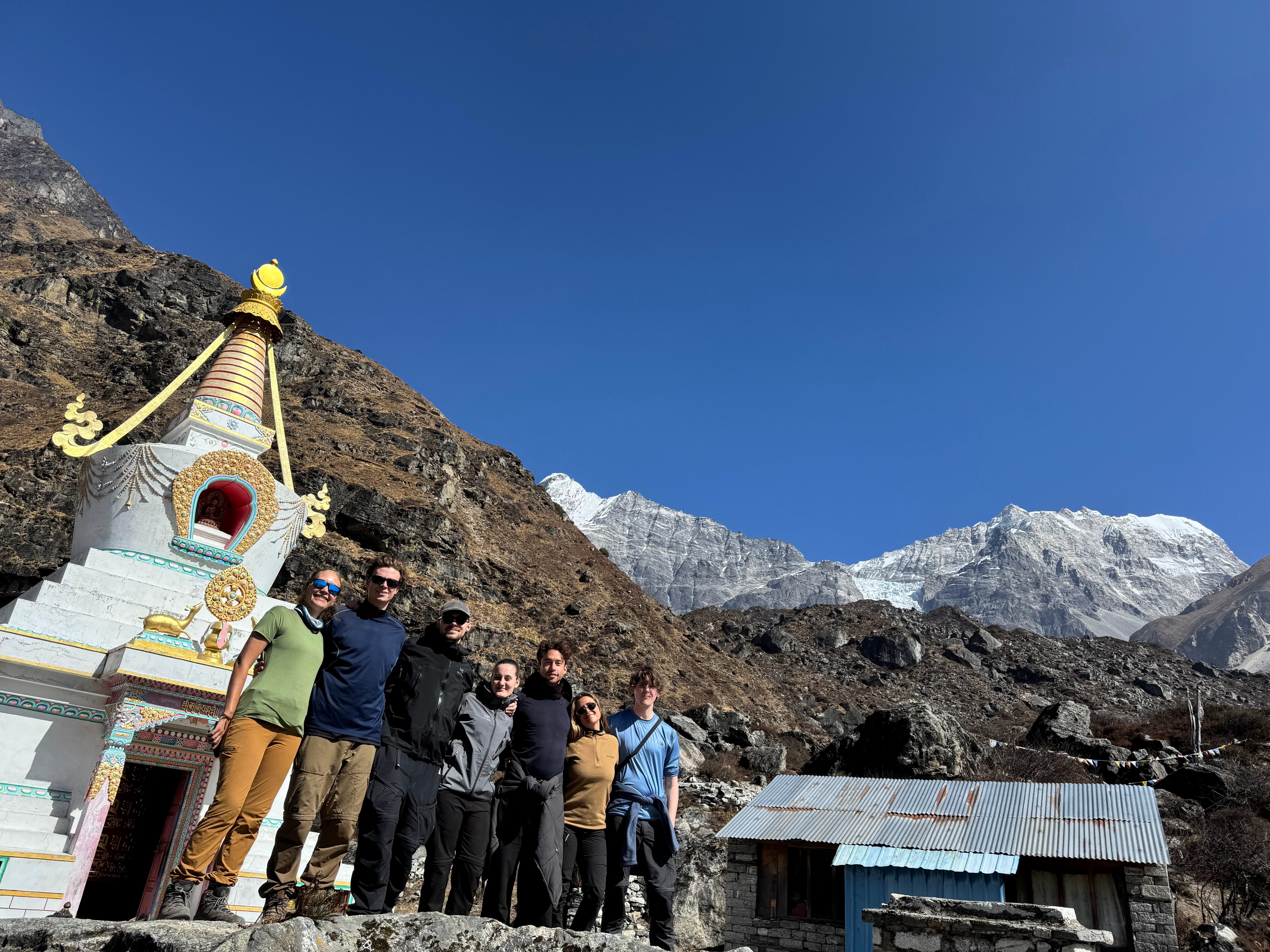
Arriving at Kyanjin Gompa - the highest village
As we got higher, the landscape flattened out, making way for larger villages and Buddhist landmarks. We passed many Buddhist temples, shrines, and stupas.
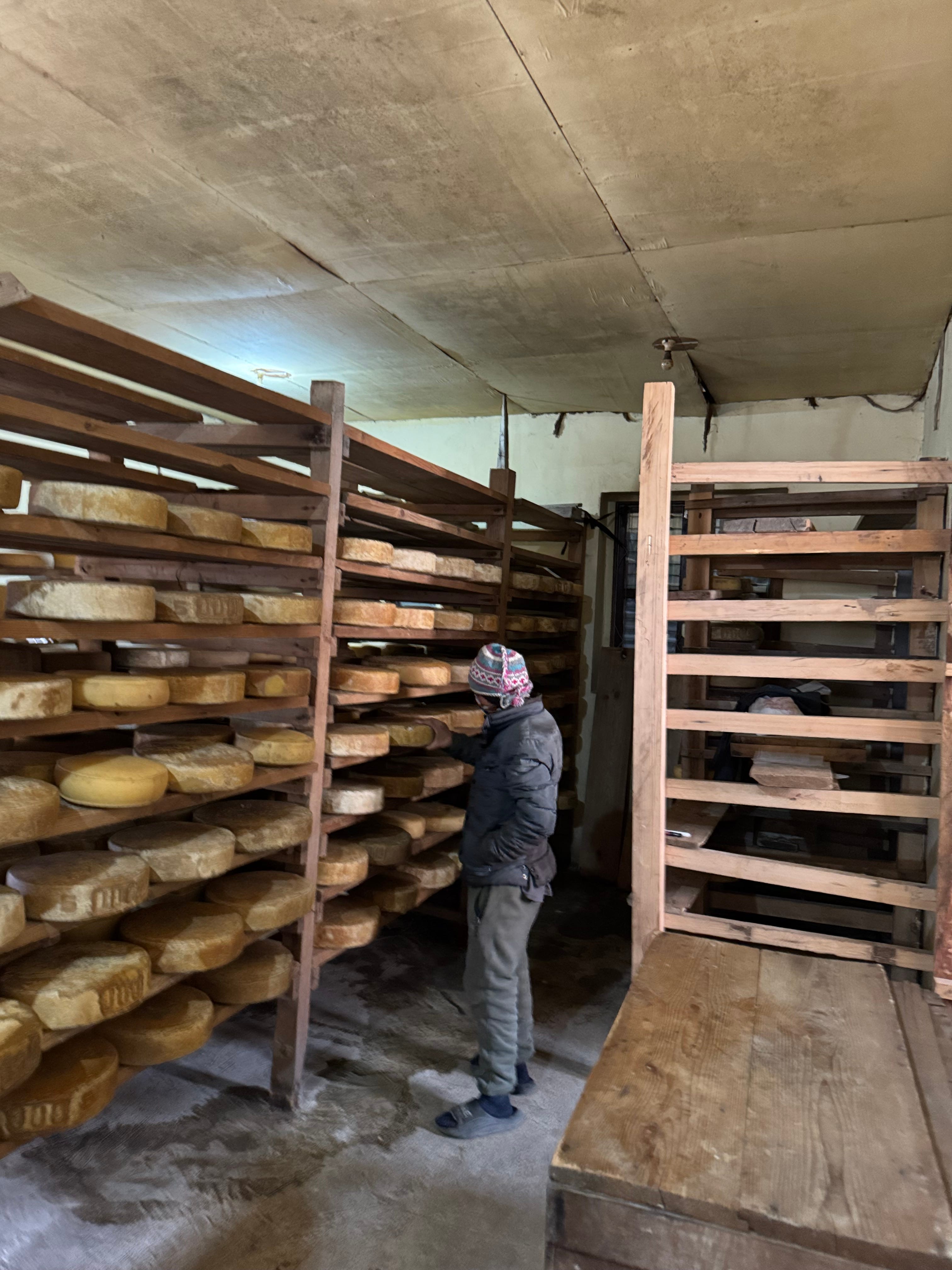
The highest village homed what I was keeping telling the group about, and which became a bit of a running joke - the yak cheese factory. I was expecting a bit more glamour to it all, but the owner barely spoke English and couldn’t show us how the cheese was made.
We bought a few hundred grams of the cheese each to fuel us for the upcoming summits. The cheese itself tasted and looked very similar to cheese made from cow’s milk, except it had a stronger smell.
Summiting Kyanjin Ri (4700m)
There are two peaks in Langtang that people frequently summit - Kyanjin Ri at 4700m, and Tserko Ri at 4985m. I was keen to do both, but most of the group wanted to just do the higher one and get down. Luckily, one of the guys in my group (Tije from the Netherlands - I got in contact with him as he hiked with the people I met in Chitwan) was to hike the lower one as he had to leave and catch a flight in a few days. The conditions weren’t ideal, as it gets misty in the afternoon, but we thought we’d go for it and have the whole mountain to ourselves.
The hike involved constant elevation gain but nothing too technical, although the altitude started getting me a little here, resulting in a light headache. Still, this was a great result compared to hiking in Kyrgyzstan with a headache for 3 days, and it only worked as additional acclimatisation. We made it to the top in great time.
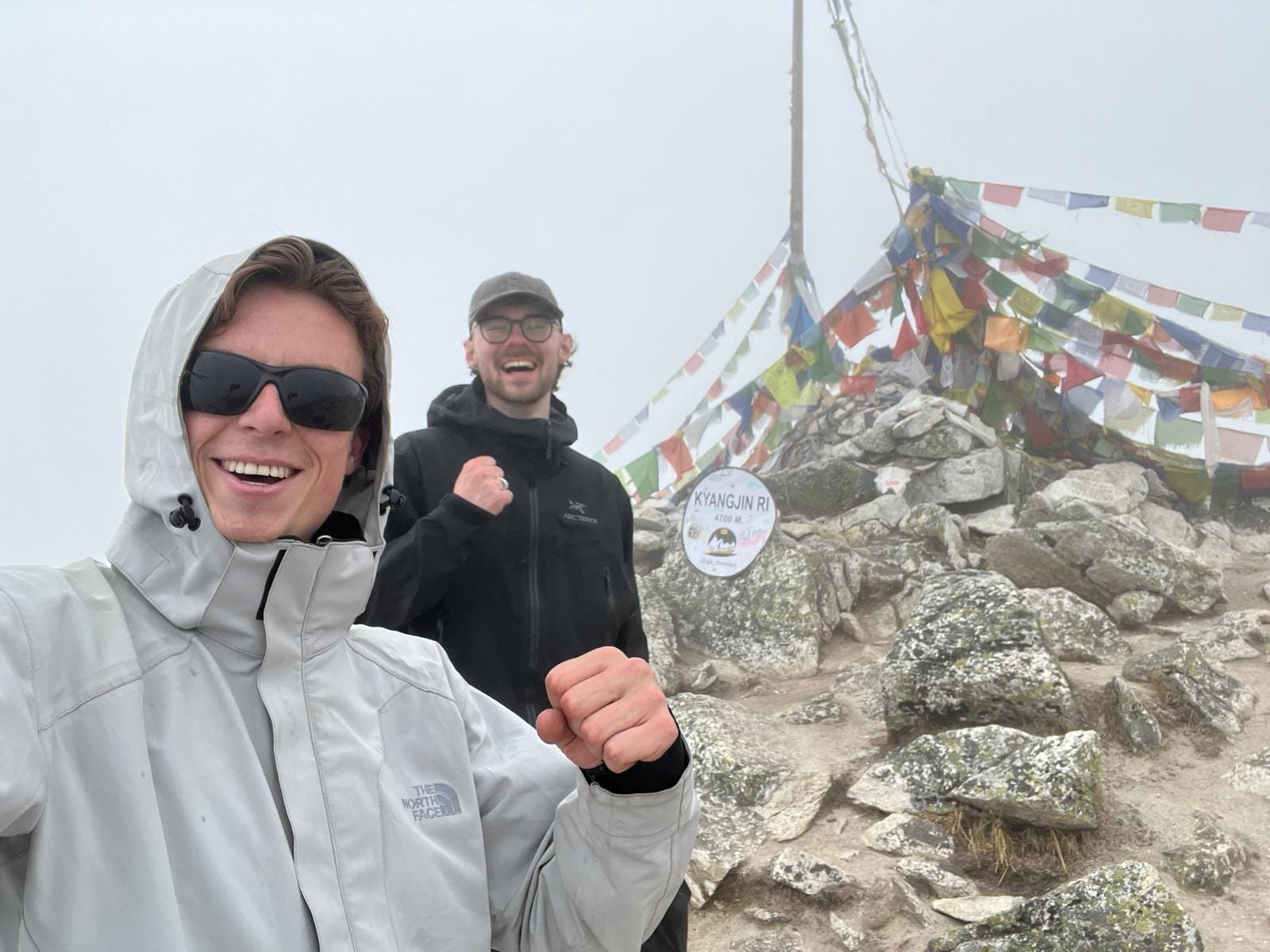
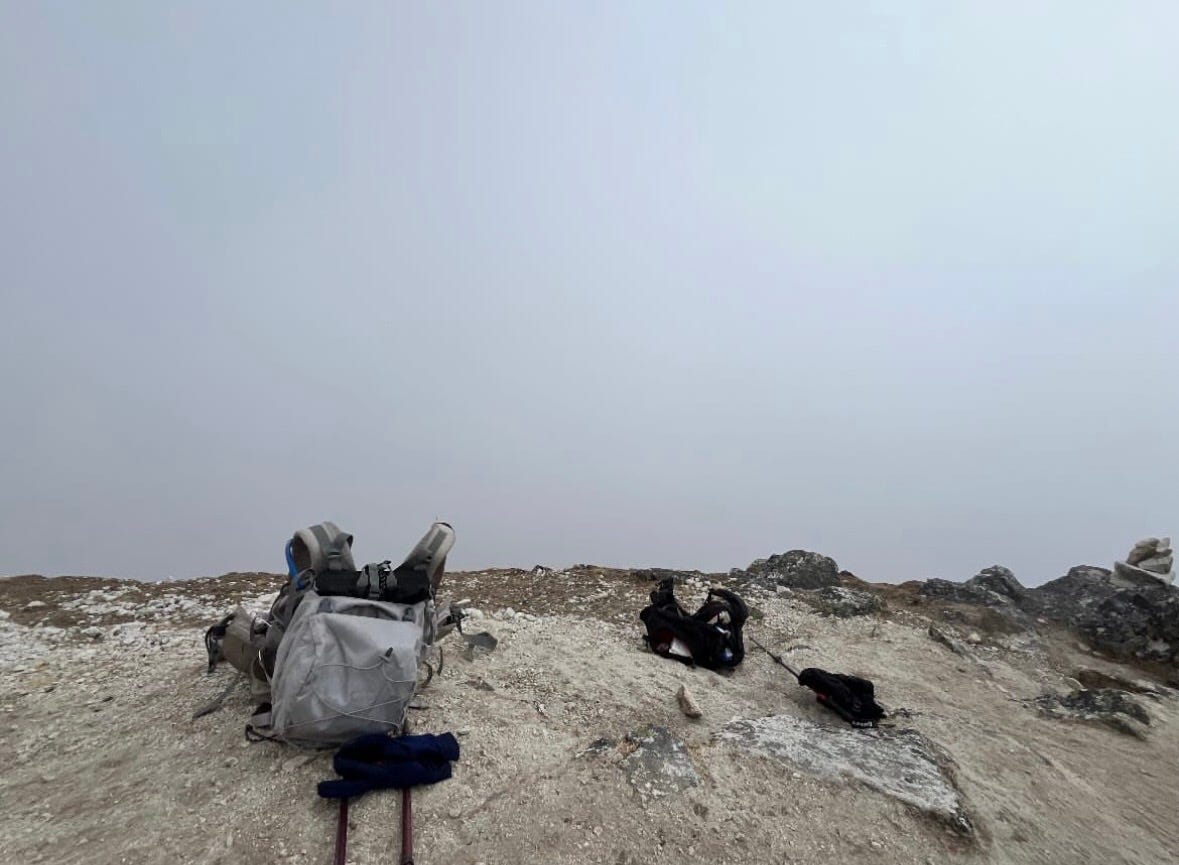
Sadly, the views were nothing to write home about.
I had quite a few seconds of dal bhat that evening.
Summitting Tserko Ri (4985m)
Tserko Ri was the highlight of the hike, being the highest peak in the valley. It can be a little treacherous towards the top, as it can be snowy, and it takes anywhere between 7-8 hours to climb, but we were well prepared. We set off at 5 AM, making it one of the earliest hikes I’ve ever done. This was well worth it, as you didn’t get too sweaty since it was chilly, and we were rewarded with some incredible views of the nearby mountains. Hiking with a headtorch also wasn’t an issue.
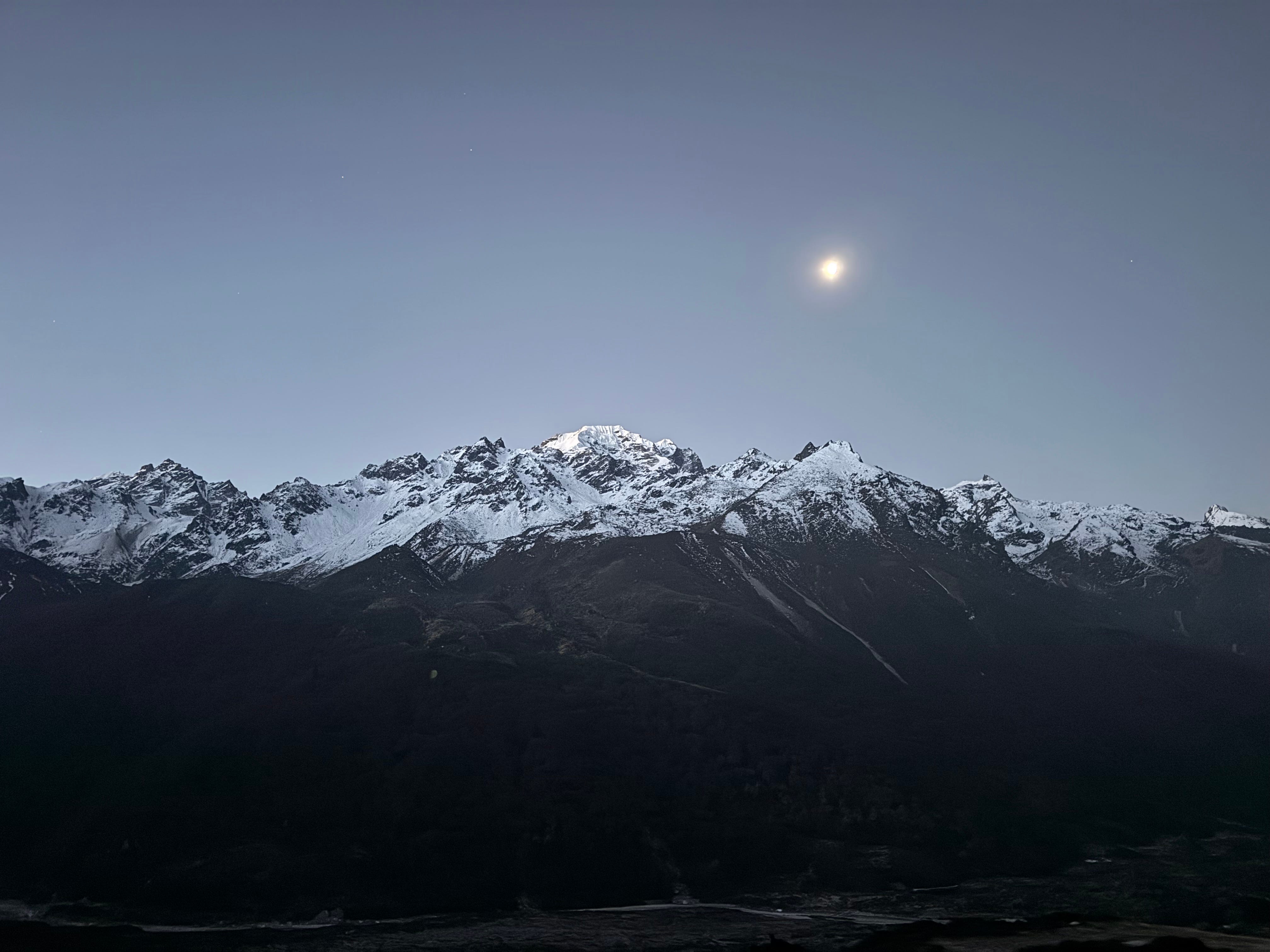
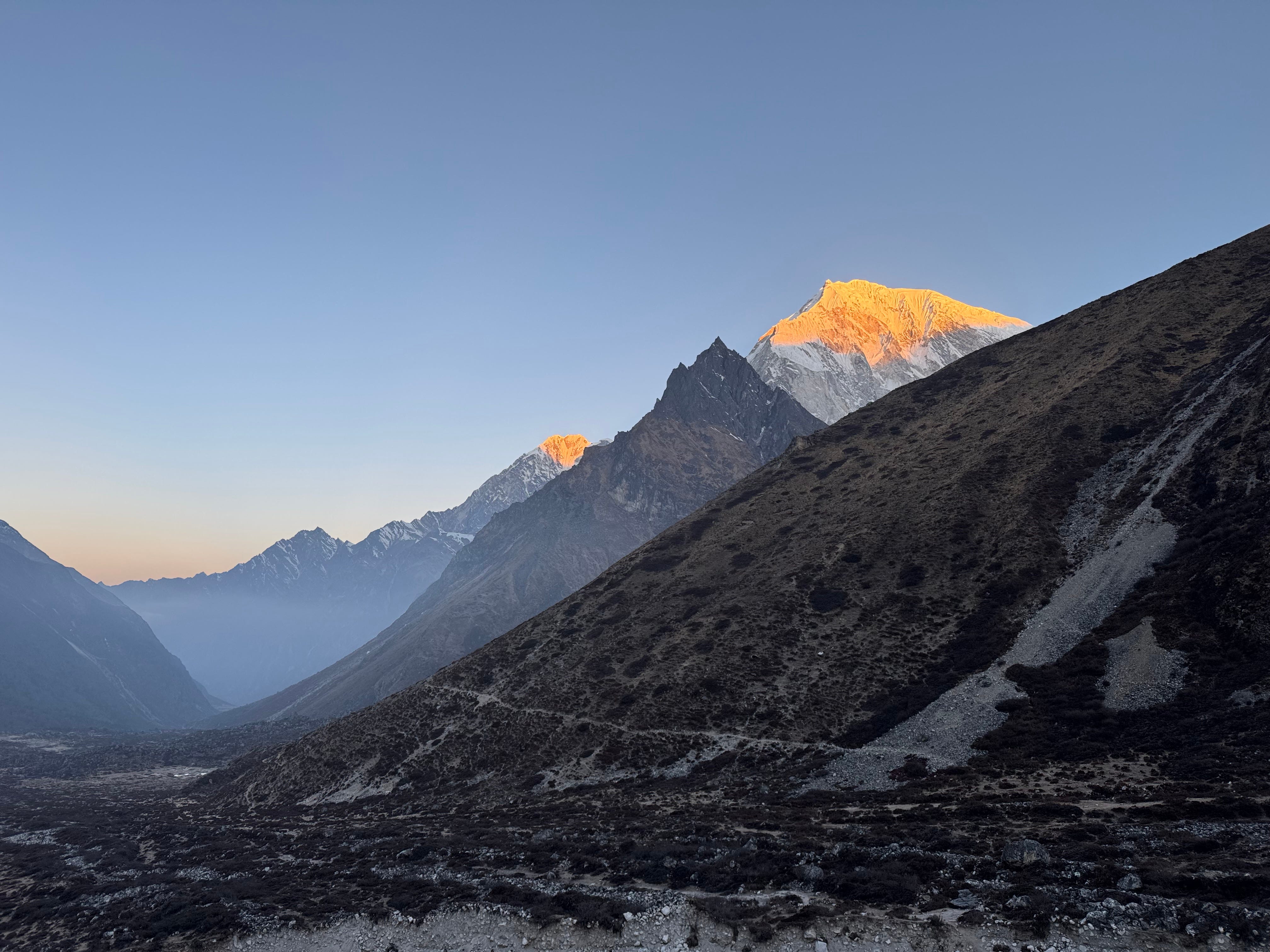
The views further developed as the sun came out, glazing the peaks in an amber glow.
We decided to take the longer, less-travelled route up the mountain with the hopes of it being a more enjoyable experience. Sadly, it being a less popular route, nobody had made trails in the snow for a while before we arrived, so we had to traverse quite a lot of waist-deep snow.
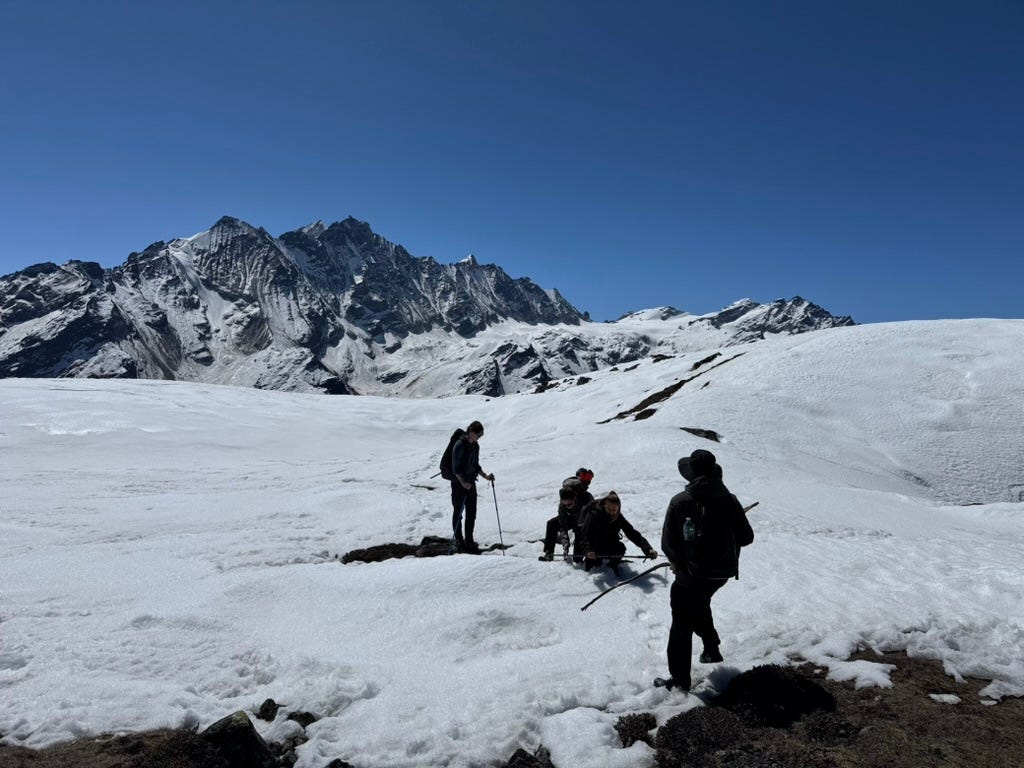
This was a bit of a sticky point in the hike. Stepping over the snow seemed dangerous, as we didn’t know what was underneath. Some of us wanted to turn back, but we decided to take it slowly and found ways to safely check how the snow in front of us was. Fuelled by yak cheese and the various varieties of nuts I bought in Kathmandu, I felt unstoppable.
The perseverance was well worth it, with all of us reaching the summit.
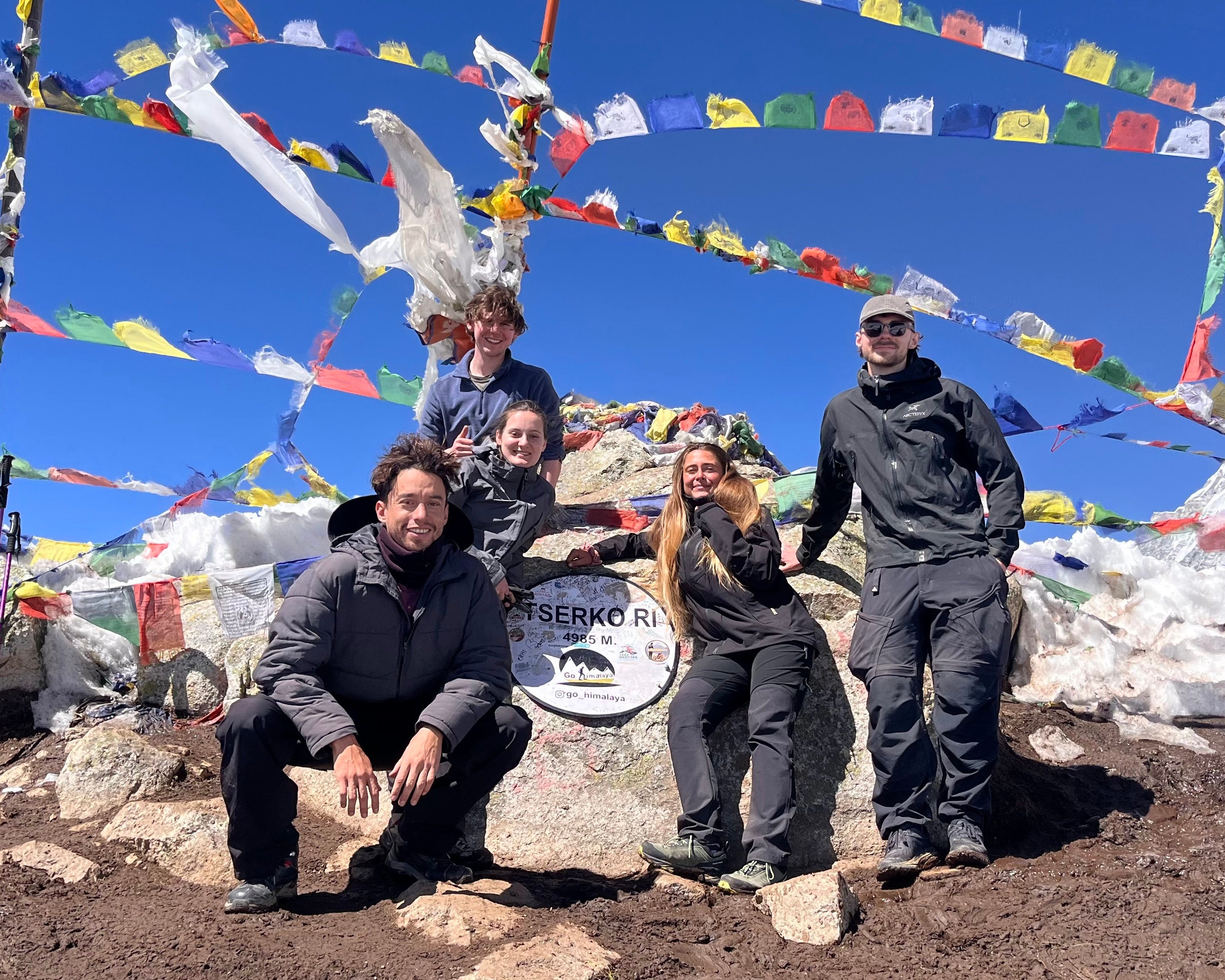
The views here were amazing. Being amongst all these prayer flags never felt better.
This was the highest elevation I’ve ever hiked to, and it felt surprisingly exhilarating. It felt a little like I shouldn’t be there, with the wind being so strong and the bottom of the valley being so far away. As cliché as it sounds, you really do feel on top of the world.
The way down was a lot more chill, with us deciding to opt for the steeper route down as the long one took us a while to get up. It was a little icy on the way down, so I put on microspikes, which I’ve never used before. I loved hiking in these; every step felt super secure as the spikes gripped the ice.
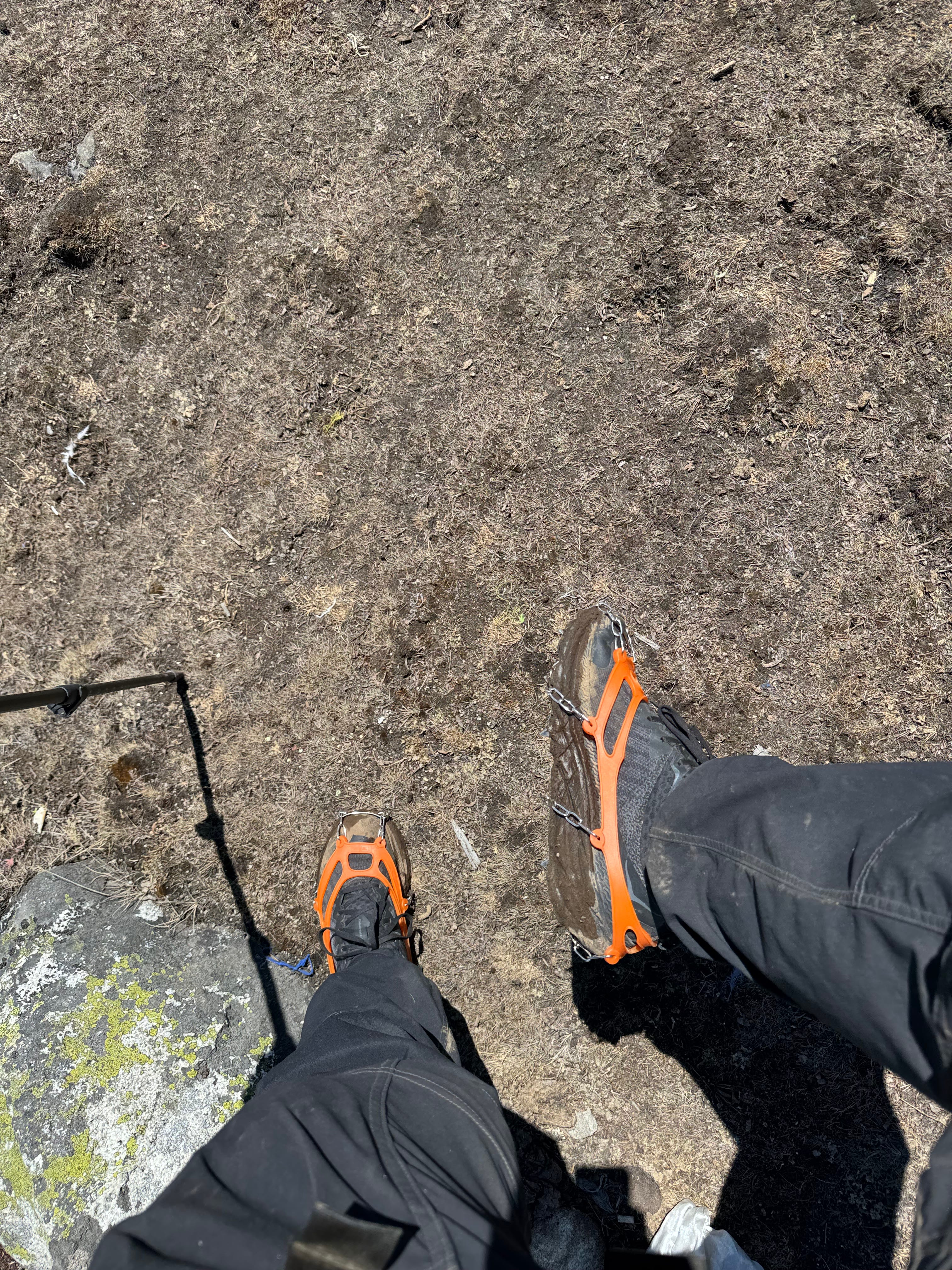
From the photo, you can also see that I’ve done the entire hike in trail runners. Many of the people in my group were sceptical, doubting that I could summit Tserko Ri in these, but it wasn’t an issue. Don’t let Big Boot get the best of you.
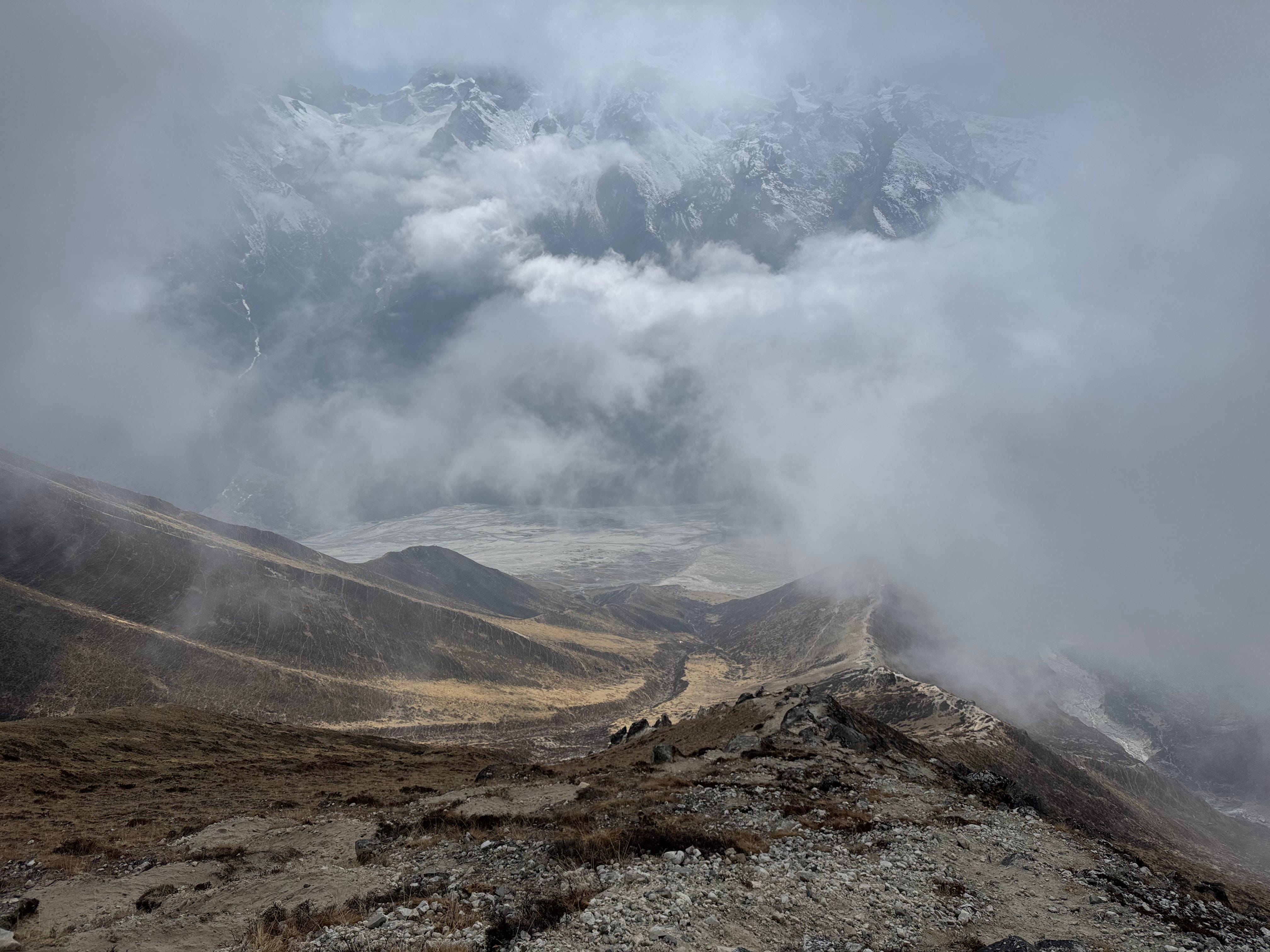
It started getting misty on the way down, making way for some really cool views.
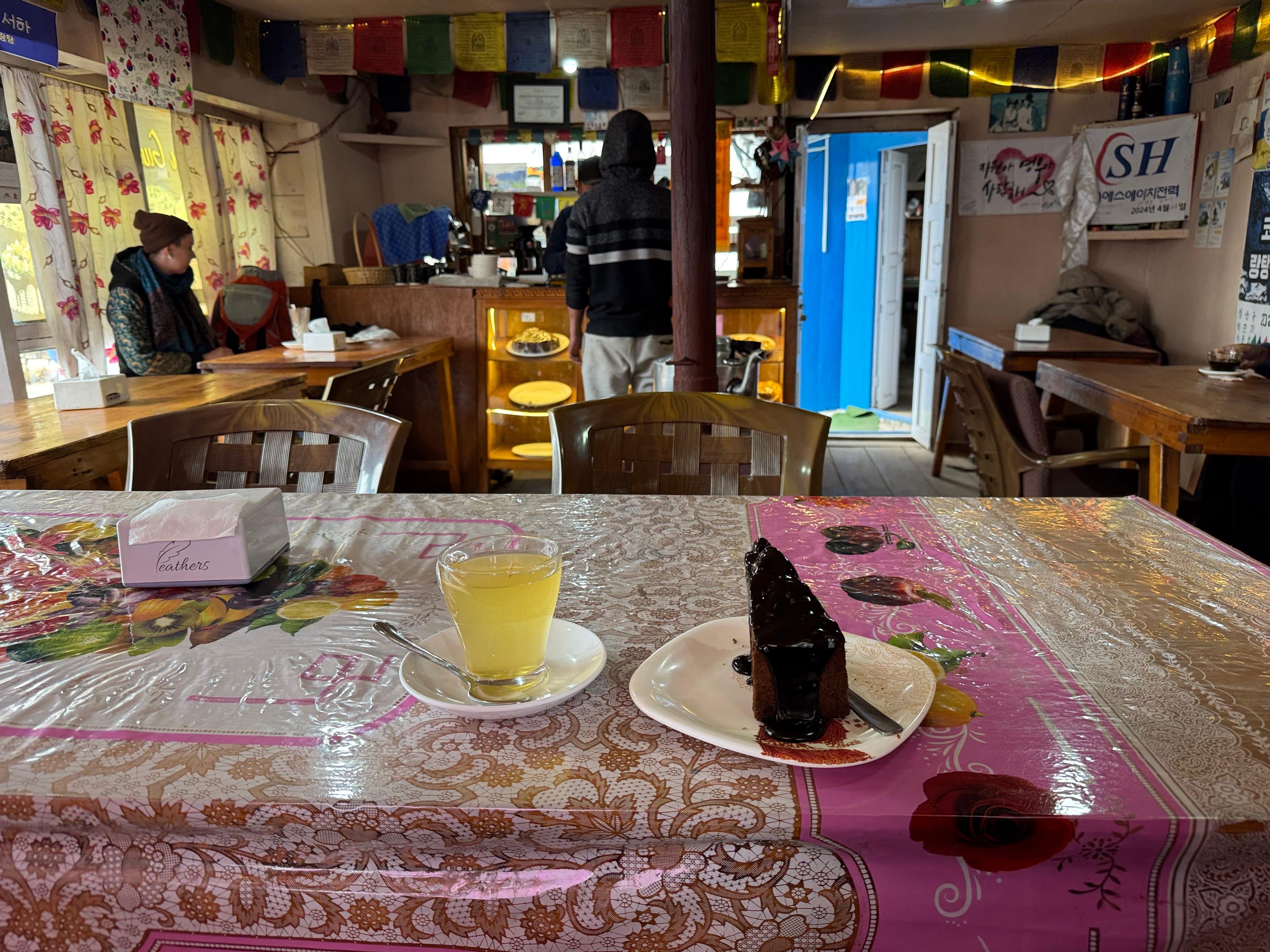
To reward ourselves after the 9-hour hike, we went to the local bakery. The bakery in Kyanjin Gompa serves perhaps the best chocolate cake I’ve ever had, and I don’t have a sweet tooth. Maybe the secret ingredient is yak milk.
The descent
The descent felt very relaxed, allowing us to see another view of the valley. Initially, I was a little unsure about going on a trek that’s not circular, as we had to backtrack, but the valley felt like a different place when going in the other direction. It was also super rewarding to effortlessly pass all the points that we struggled with hiking up before. The descent was also quite misty on one of the days, resulting in more incredible views.
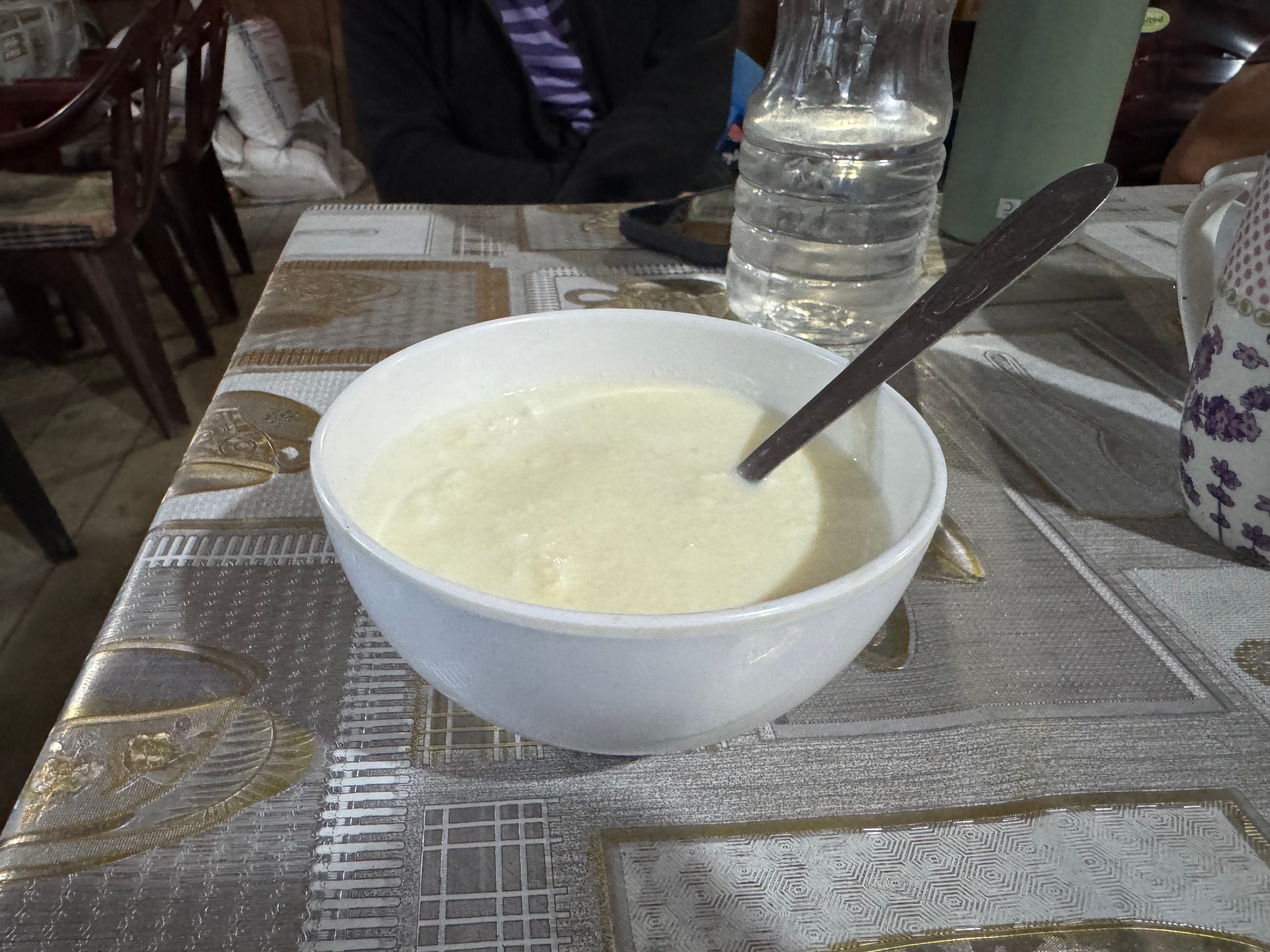
There were 2 small highlights on the way down - the best Masala tea I’ve ever had, and yak yoghurt. I’ve been asking for yak yoghurt in every teahouse that advertised it outside, but nowhere seemed to have it. We got lucky on the descent, and one teahouse had it, but it was pretty unimpressive. It just tasted sour.
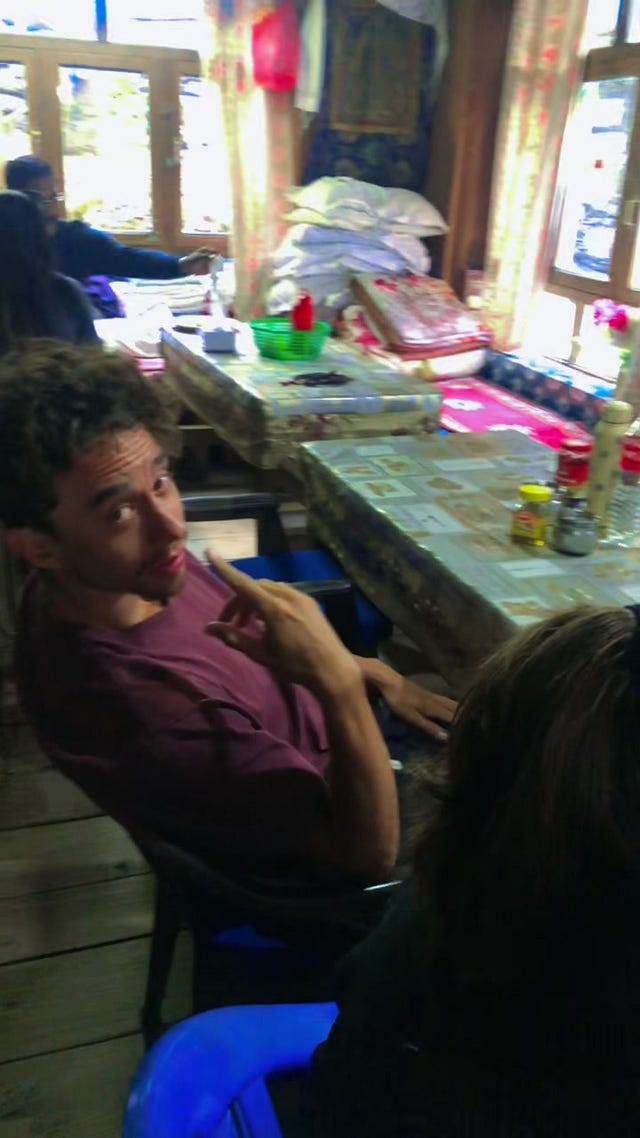
We stayed at Karmu’s place on the way down again, a situation she commemorated by recording another TikTop with us:
 Tiktok failed to load.
Enable 3rd party cookies or use another browser
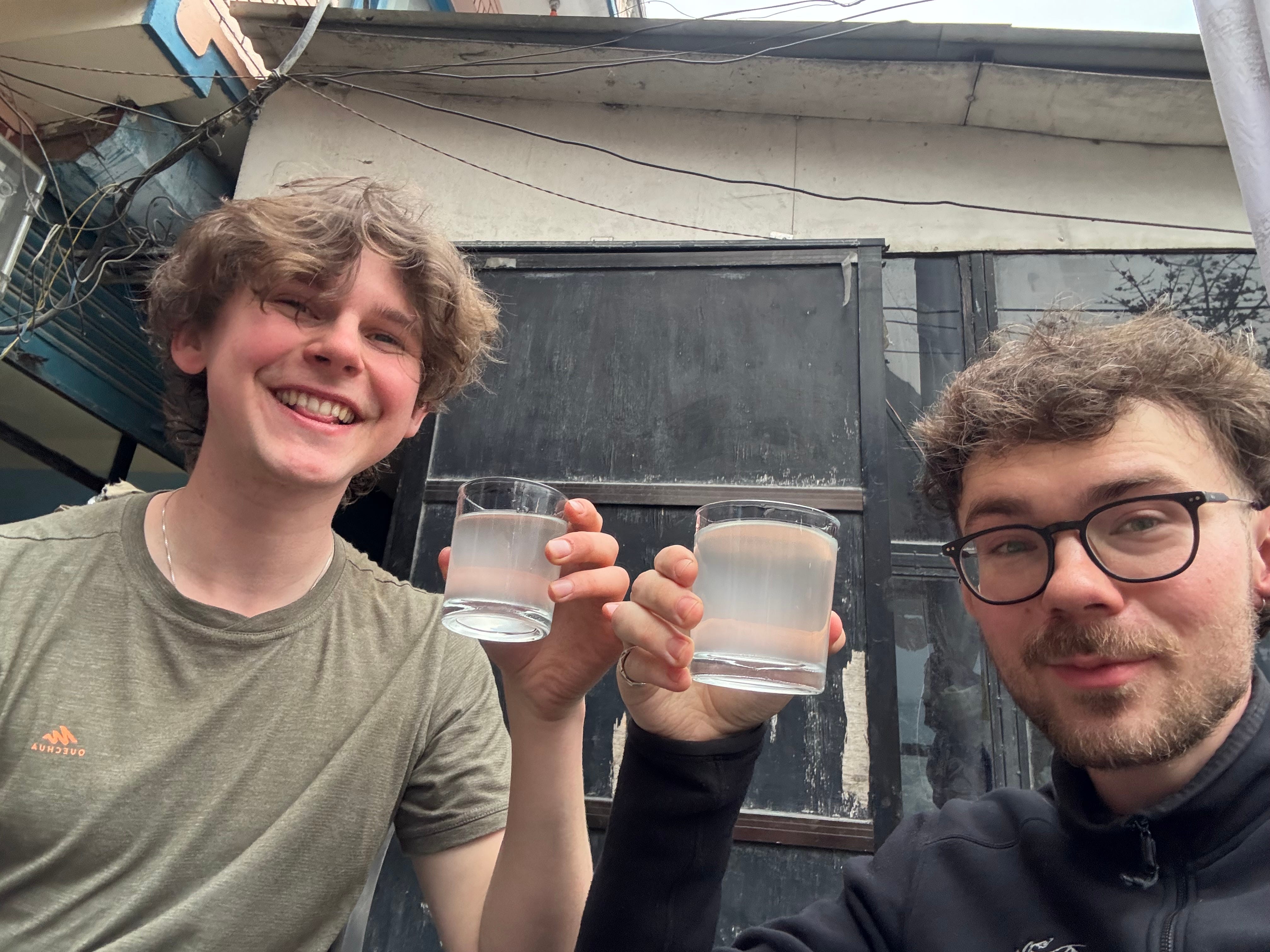
After two days of descent, we got to the starting village again. To celebrate, I got some homemade rice wine called Raksi with Ollie (a Brit in my group). The guy in the cafe laughed at us when we got it, and it was for good reason - it tasted like an unrefined spirit. For 50p a glass, we couldn’t complain much, though.
Trek costs
A few people asked me about the costs of this hike, which I’ll try to roughly break down. Aside from the costs of gear and any snacks you might bring with you, they looked as follows:
Trekking permit: 3000 NPR (£15.36)
Transport to and from the starting point: 2000 NPR (£10.24)
Food: 2000 NPR (£10.24) - 3000 NPR (£15.36) per day
Accommodation: 0 NPR - 1000 NPR (£5.12) per night
Yak cheese: priceless
For the whole 7 days of trekking and two days of transport either side, I paid around £140.
Having calculated it, I can’t quite believe the costs were so low. If you were to book a guided tour of the Langtang Valley online, the prices would be around triple. Saying this, I’d only recommend going without a guide and booking things yourself if you’ve hiked a bit before.
Final thoughts
This hike was easily one of the best hikes I’ve ever done. The scenery was incredible, the food was amazing, and staying in teahouses made it easy to keep hiking for many days. I’d love to be back and hike more in Nepal.
If you enjoy hiking, I’d really recommend coming here. There’s a lot going on in Nepal in terms of its development, and tourism feels like a great way to support the country. You also don’t need to figure everything out before coming here - there are hiking shops on every street corner, and the locals are keen to help without expecting anything in return.
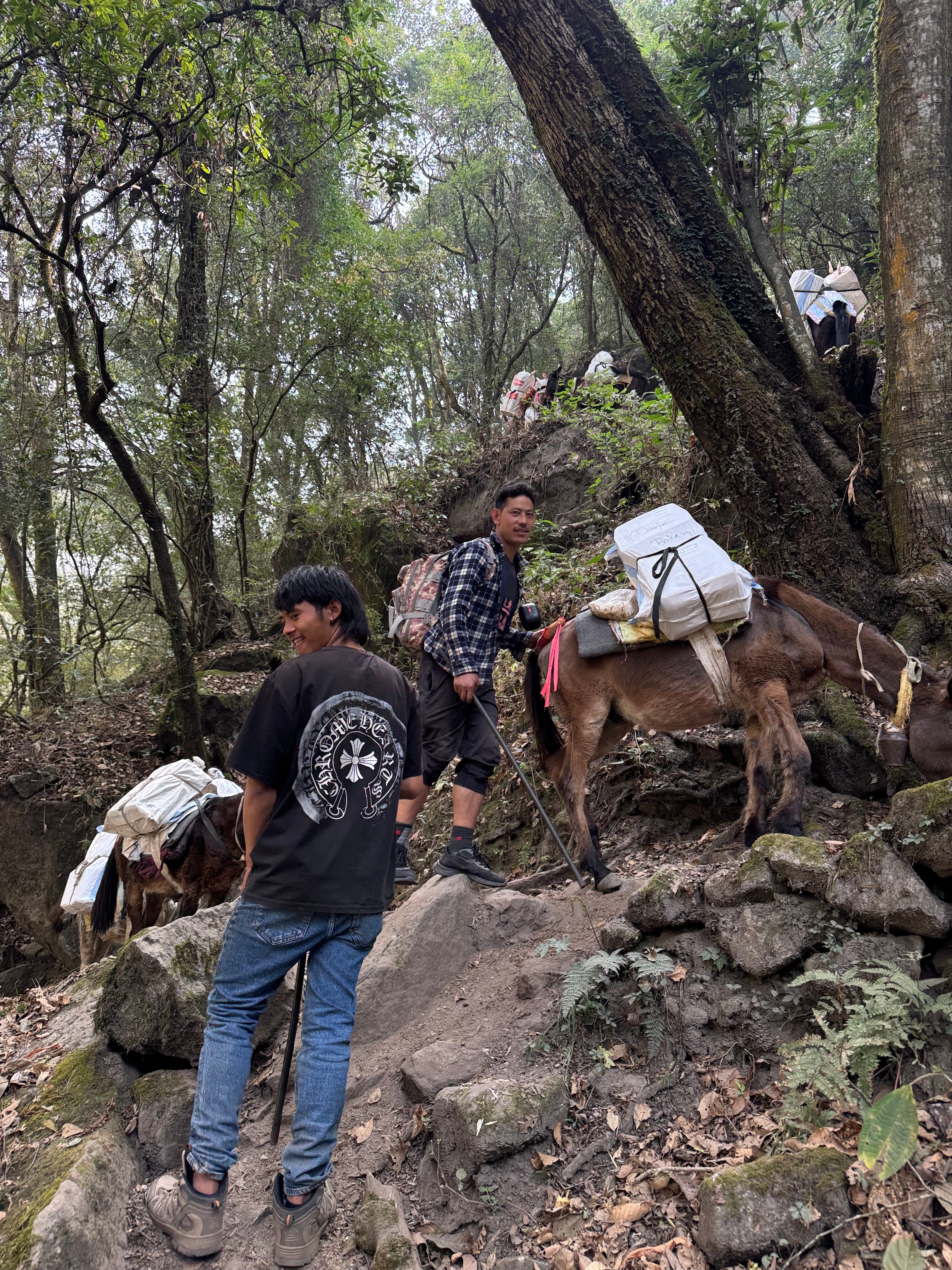
Either way, no matter how much you prepare, you’ll always be passed by a Nepali guy on the trail who’s wearing jeans, flipflops, a tiny backpack, and a fake Chrome Hearts t-shirt, all whilst blasting Nepali reggaeton, while you’re at your limit. They build them differently here.