
🇮🇳 10-Day Silent Meditation Retreat in Jaipur (Vipassana)
Defragmenting my mind
During my stay in Jaipur, I completed a 10-day Vipasssana course. Vipassana is a meditation technique made popular by S. N. Goenka - a Burmese businessman-turned-meditation teacher. I’ll try to summarise what the course was like and how I found it in this post, although it may get a little rambly.
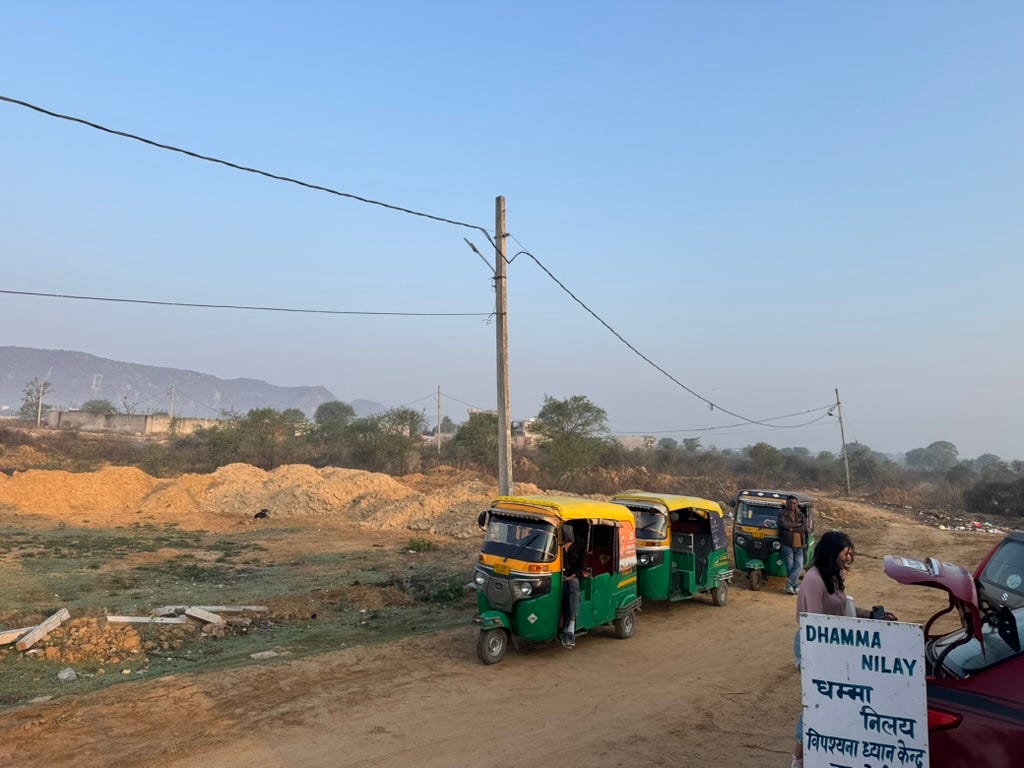
Background
Having done some shorter meditation retreats (two 3-day ones and one 5-day one) under the Triratna Buddhist tradition through the London Buddhist Centre in Bethnal Green, I was excited to attend this one for a few reasons:
It’s long - 10 full days, with a half-day on either side. That should have really let me go deep on meditation more than I ever have before, and I was curious what would happen with my mind during this time.
It’s highly regarded - Vipassana is very popular worldwide, with many people having seemingly gotten lots of value from it.
It’s non-sectarian - despite its core technique being heavily rooted in Buddhism, the course doesn’t endorse any sort of organised religion. The retreats I’ve done before were all Buddhist, so I was curious how others looked like.
It seemed hard - I wanted to take this on as a personal challenge.
I didn’t need to do this course in India, as there are centres for it all over the world. However, since they usually book out months in advance, I booked it towards the start of my travels so that I can be more flexible with travelling after I was done.
The course itself is entirely donation-based, and there isn’t much push at all during it to donate. In fact, I’ve been trying to donate, and they’re not making it easy - as a foreigner, I need to submit some extra information, and nobody is getting back to me from the contact numbers and emails listed on the centre’s website.
Course Structure and Rules
The course structure was pretty much the same every day, which is as follows:
4:00 am: Morning wake-up bell
4:30-6:30 am: Meditate in the hall
6:30-8:00 am: Breakfast
8:00-9:00 am: Group meditation in the hall
9:00-11:00 am: Meditate in the hall or in your room according to the teacher’s instructions
11:00-12:00 noon: Lunch
12 noon-1:00 pm: Rest or questions with the teacher
1:00-2:30 pm: Meditate in the hall
2:30-3:30 pm: Group meditation in the hall
3:30-5:00 pm: Meditate in the hall or in your own room according to the teacher’s instructions
5:00-6:00 pm: Snack break
6:00-7:00 pm: Group meditation in the hall
7:00-8:15 pm: Teacher’s Discourse in the hall
8:15-9:00 pm: Group meditation in the hall
9:00-9:30 pm: Optional question time in the hall
9:30 pm: Retire to your own room--Lights out
There was also a 5-10 minute break between each session. There are two things that I really struggled with in this timetable - the sheer amount of meditation every day (10 hours), and the short window of sleep opportunity (7 hours if not staying up to ask the teacher anything).
I value my sleep, so about 6.5 hours a night was not enough. I ended up napping after breakfast and lunch every day, as the breaks were long, to make up for it. The 2-hour meditation session in the morning was also a complete write-off, as I just focused on not falling asleep. Others also struggled with this, and you could hear some occasional snores. I don’t see why those breaks aren’t shortened and the opportunity to sleep extended - I felt like a zombie every day until after my lunch nap.
I also couldn’t stray from the timetable unless I had a good reason for it (e.g. I was sick). If the organisers saw you still in bed when the bell rang, they would come in to your room and try to get you out of bed.
There are also 5 precepts you have to follow:
Don’t kill living beings.
Don’t steal.
Don’t perform any sexual misconduct.
Don’t lie.
Don’t take intoxicants.
Those were easy enough to follow. There were also a few other rules:
No verbal or non-verbal communication with other students. I could talk to the teacher during question sessions, and the volunteers, if I needed a hand with anything, though.
I wasn’t allowed to use my phone.
Men and women were separated and were not meant to mingle in any way.
I couldn’t exercise, aside from walking around the courtyard.
I wasn’t allowed to write or read anything.
I think the last two rules were good, and were unlike other retreats I’ve been on. It really forces you to focus on your mind and meditation without distraction, despite it making things more difficult.
The technique that was taught was fairly simple at heart, with many commonalities with other meditation techniques I’ve done before. I won’t get into it too much, but it focuses a lot on your breathing and feeling sensations in your body, while requiring you to not react to any unpleasant sensations and instead letting them to pass. It’s fairly simple, but every bit of complexity that was added made a difference since you ended up meditating for 10 hours a day.
My Experience
Honestly, the retreat was tough at many points. Doing nothing but meditating ended up feeling quite laborious, and I got various pains in my body after sitting for 10 hours a day. Other retreats I’ve been on were nicely broken up by being able to read, listen to Buddhist teachings, and chat to people (who seemingly all either have a neuroscience background or are hippies from Bristol - not people I encounter every day).
The silence was mostly fine to deal with, but not being able to share my experience with anyone felt quite alienating, especially in the first few days. At the same time, it meant that other people’s experiences couldn’t impact my own.
As for any sort of revelations I had, I was able to meditate deeper than I have before, which is sort of a dragon I’ve been chasing since I started meditating in group settings 6 years ago. Aside from the mediation, having so much time to think without distractions allowed me to process experiences from the past that I honestly didn’t think I needed to process more. It made some things clearer to me, and my mind feels a lot more in tune.
I also found that my mind was going weird places in the absence of any novel stimuli. Apart from a new birdsong or insect sound being a big deal, my mind was occupied quite a lot thinking about music and films that I like, especially ones from the past I rarely think about. I’ve also ended up recalling various old, mundane memories that I’ve completely forgotten about. With that, I also had some incredibly vivid dreams mostly relating to family members, especially deceased ones.
At the end of the retreat, I feel like I’m extra sensitive to the feelings of people around me. In general, talking about emotions is easier and more intuitive, but some things feel a little overwhelming. I felt similarly after shorter retreats before, but not to this degree. Saying this, I’ve had a similar experience after other retreats, and most of this effect will slowly fade in the coming weeks.
Taking the Course Abroad
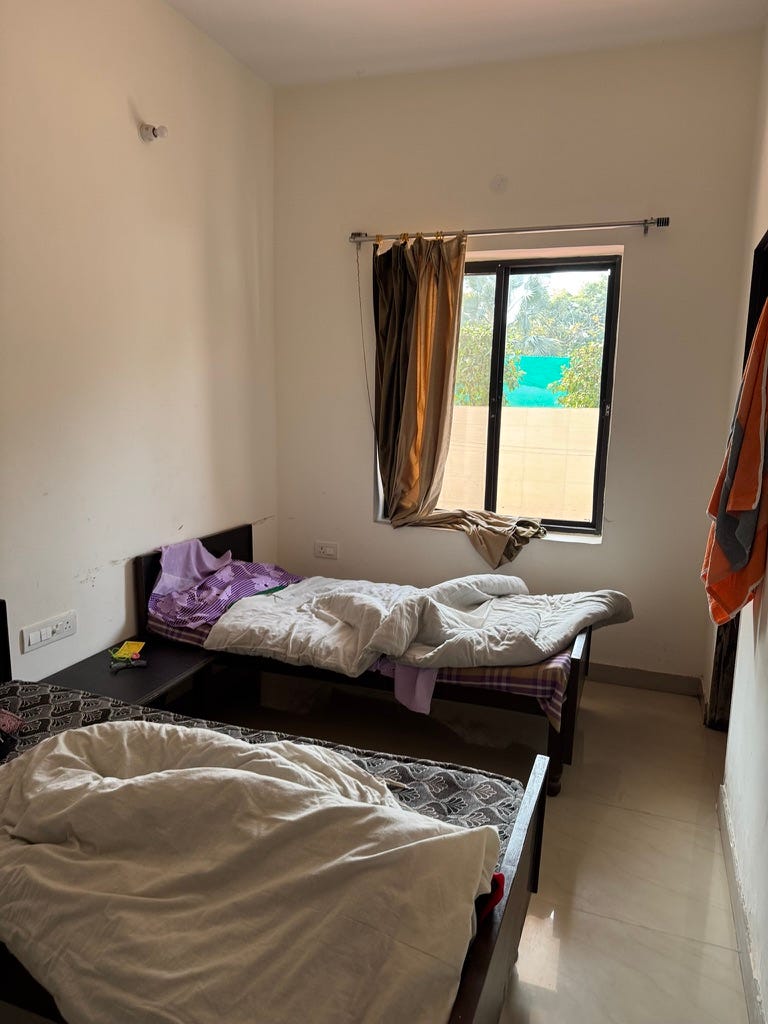
Taking the course in India has added a significant challenge that I haven’t found in meditation retreats in the UK. My meditation centres I’m comparing my experience to are Vajrasana, which has an article on The Guardian about it, and Adhisthana, which looks a bit like a manor house. Instead, I stayed in what looked like student accommodation.
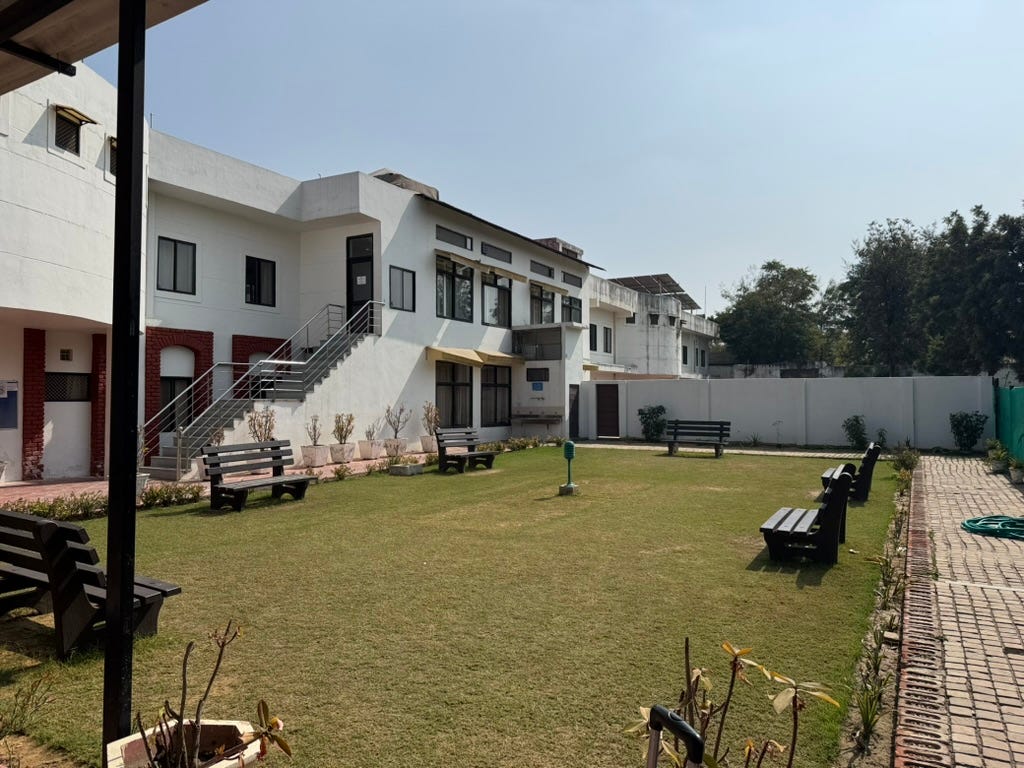
The manners were also a little different from what I was used to, with other students openly farting, coughing, snorting, and burping for the whole 10 days. In a sense, it added some complexity and provided some extra things to try not react to.
There was also no toilet paper in the building and none of the bathrooms had bins (you can’t flush toilet paper in India), so I’m assuming everyone was running around with wet bideted bums like me.
Sleeping was also tough, with the beds too small and the mattress seemingly backed by a wooden plank. This especially started becoming a problem a few days in, but I got used to it.
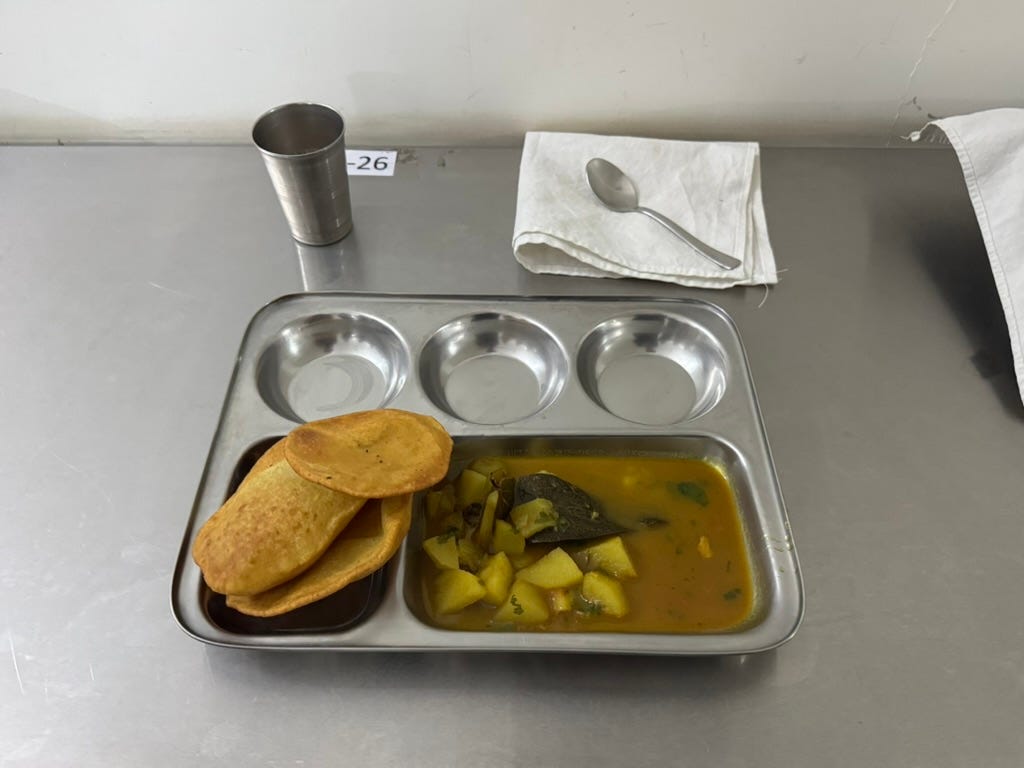
A nice perk of the retreat was having pretty tasty Indian food. Every day, there was something different for breakfast and lunch. I usually had two courses - one taking small samples of everything to check what might kill me, and another one doubling down on the tasty stuff. I’m not sure what half the stuff was, as I couldn’t ask, but some of it was great. I went for two courses as I had explosive diarrhoea during the first 3 days of the retreat (likely a continuation of what I got in Agra), which I also sadly couldn’t apologise my well-mannered German roommate about.
I got one photo of how the final breakfast looked, which is one of the simpler ones they gave us (and yes, I’m aware it looks like a prison meal).
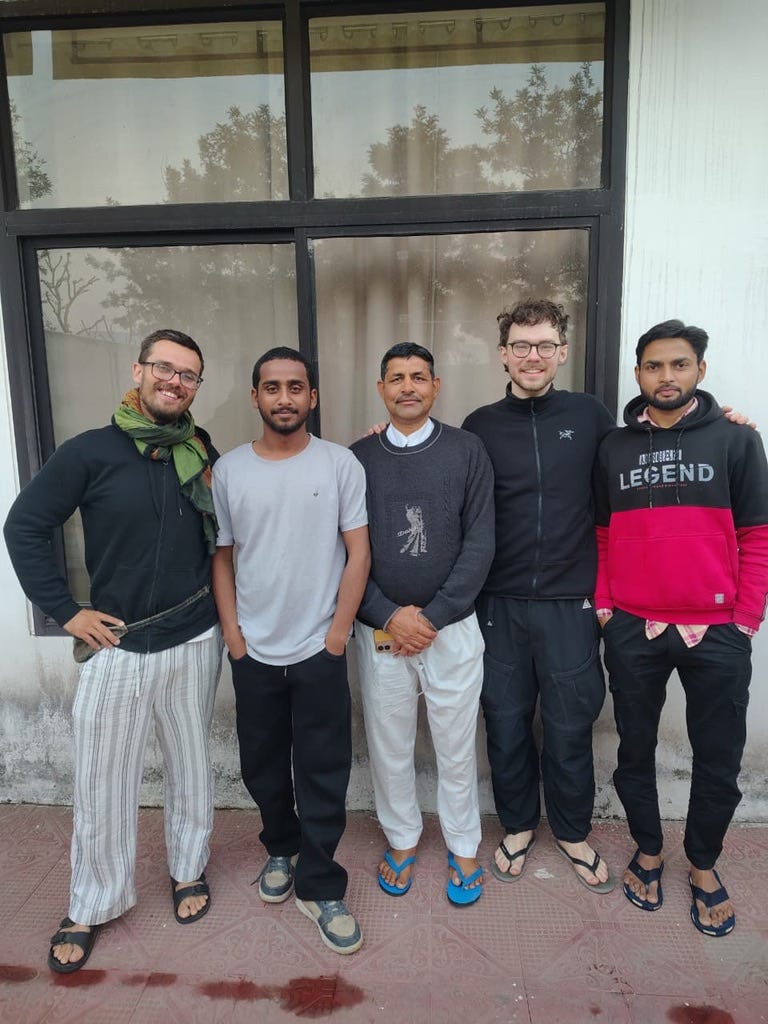
Of the 30 men at the retreat, there were two other foreigners. We effectively ended up having a photoshoot with all the Indians on the last day as many were very keen to take photos with us. Some also invited me for food to their homes and offered to travel around India with me. As a foreigner in India, I could have come here without a plan and just spent months getting pampered by the locals.
Final Thoughts
I’m really glad I did the retreat and came out with a lot from it, although I’m still assimilating the experience. I didn’t have any particular revelations, unlike the other attendees, but it was a valuable experience either way. One of the guys also started manically screaming as soon as the silence was over, so I guess things could have also gone differently for me.
Maybe I won’t come back to London with elephant trousers and dreadlocks after all.
I am on the toilet at work laughing at this
i think i would end up like the screamer with my twisted perspective on this dark reality... a full glimpse into my own mind would simply drive me insane